
Key Takeaways
- Whilst patriotism, national pride and broadly defined nationalism have always had a role to play in Chinese communist politics, they have taken on an ever-greater significance in recent years.
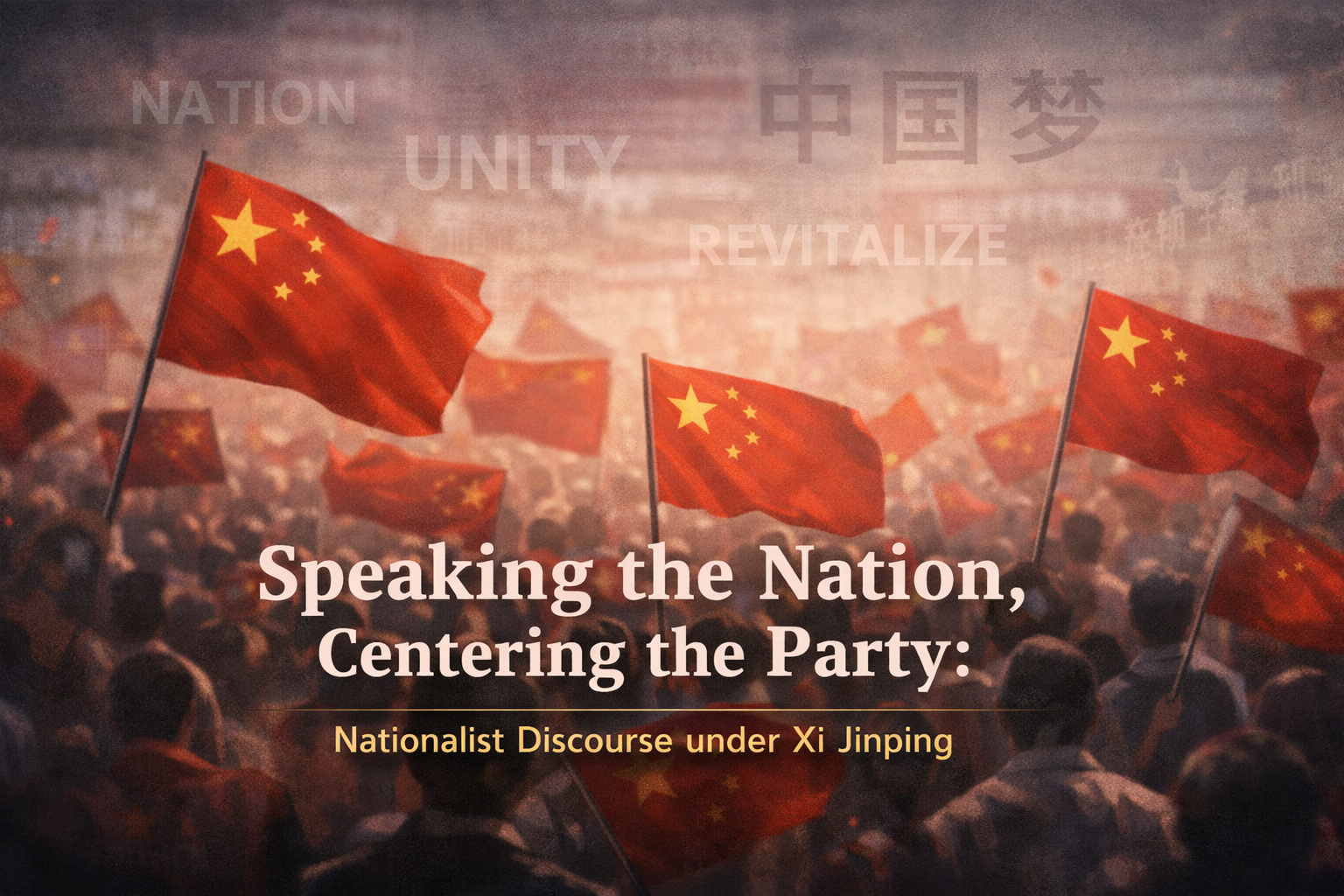
- The party’s official discourse – how it describes itself and talks about itself - frames the CCP as the defenders of China’s national interests and as the only agent capable of realizing national goals.
- This party wants to make idea of the CCP as the natural and only party capable of delivering national rejuvenation so embedded within society that it becomes difficult (to say the least) to criticize or question.
- Ongoing theoretical innovations are increasingly emphasizing the “exceptional uniqueness” of Chinese culture, focusing on continuity and the historical importance of unity, and the current party as the inheritors of his great culture and civilization.
- At the same time, the discourse is arguing both for an ever-greater centrality for the party across all sectors of society, and also for the centrality of Xi Jinping as a leader. His personal authority at times seems to be more important than the power of the party itself.
- The evolution of Chinese nationalist discourse in the Xi Jinping era is more than just rhetorical adjustment. It is a process of adaptive consolidation, through which the CCP has solidified its legitimacy by redefining the discourse of Chinese national rejuvenation to sustain its centralized authority and project China’s distinct (and non Western) political trajectory.
Introduction
There are two recurring and underpinning themes in the political economy papers for the EH4S project. The first is that Chinese leaders are committed to bringing about a massive and fundamental shift in the nature of economic activity, and the transition to a new model is already underway. The second is that this is more than just an economic transition. It is inherently a political transition as well, as it impacts on the way that the Chinese Communist Party (CCP) manages its relationship with the Chinese people and justifies (and maintains) its leadership (and the nature of the political system more generally). This political task entails first deploying the Party’s extensive propaganda apparatus to explain the leaderships’ new objectives. The next step is then to establish the attainment of these goals as new indicators of good and effective performance that the Party should be judged against.
This in part involves instituting new benchmarks for evaluating economic performance; for example, to no longer simply calculate the quantity and the amount of growth but to instead focus on the quality, sustainability, and the utility of growth. It also necessitates looking beyond economic performance to other issue areas to prove that the Party is succeeding in delivering what the Chinese people need and want (and are told that they need and want). Chief among these other areas is the Party’s ability to deliver “the great rejuvenation of the Chinese nation”; to take China back to where it belongs as a major power, despite the best efforts of others to prevent it from re-establishing itself. Perhaps we can call it the goal of nurturing nationalism and national pride. And while this emphasis on nationalism is certainly not new, like many things it has been taken to a new level under Xi Jinping. Moreover, not least because of what has happened to Western powers (including great ones), the time seems ripe to complete that rejuvenation and for China to play an ever-greater global role; and who knows, at some point maybe to become THE major power.
While it might be difficult to calculate the success of this strategy, this hasn’t stopped people from trying. The 2025 twentieth annual survey on “How Chinese View the World” conducted by Global Times – an affiliate of People’s Daily, the official mouthpiece of the CCP - found that the Chinese public exudes pronounced confidence in China’s status as a major power with 76 per cent of respondents expressing pride in their Chinese identity.[1] In the 2025 Guangzhou Youth Development Report, over 90 percent of surveyed university students reported a strong sense of national pride and cultural confidence and called for an even greater emphasis to be placed upon patriotism.[2]
Given that both surveys were conducted through official channels, then it might seem reasonable to suspect that they have been manipulated to prove a point. Yet research on public opinion in China suggests that survey results are more robust and representative than is typically thought to be the case.[3] For example, surveys conducted by the University of Chicago in 2025 arrived at strikingly similar conclusions to the Chinese ones, with the growing confidence and patriotic sentiments of the Chinese populace linked to both concrete improvements in living standards within China itself, and China’s enhanced global stature.[4]
Our main interest here, however, is not to evaluate the results as to understand the process; to highlight how the Party has tried to establish the importance of national pride and rejuvenation as a key goal and indicator of success, and to establish itself as the only agent or actor that can deliver this success. To do so, we focus on the shifts in nationalist discourse in the Xi Jinping era, with a particular emphasis on how what at first sight can look like minor or subtle changes in language can actually signal rather profound and fundamental shifts in the way that the Party justifies its leadership and monopoly of power. The first task is to delineating key terminologies central to Chinese nationalism, and then to provide a concise elaboration of the concept of a “common sense” which we think is essential in understanding how ideas and concepts essentially become un-challengeable in Chinese politics, and simply accepted as being true.
Nationalism, Nation, and Chinese National Rejuvenation
Every Chinese leader since Sun Yat-sen has invoked what is now typically referred to as “the great rejuvenation of the Chinese nation” as a central political aspiration.[5] Even Mao’s focus on the importance of winning a class war was framed by doing what was right for China and the Chinese people in the long run (rather than, for example, what was right for the global Marxist movement). After all, the China that the CCP was born into in 1921 was, in the CCP’s own understanding, suffering from both (domestic) feudal and (foreign) imperial suppression and oppression, and the revolution that brought it to power was at least in part about restoring China’s borders and Chinese sovereignty. As Mao himself put it as he prepared to establish the new People’s Republic of China in 1949, “ours will no longer be a nation subject to insult and humiliation. We have stood up.”[6] That said, the emphasis on class politics and class warfare under Mao does stand in stark contrast to the focus on attaining national goals that has become the norm since Deng took de facto control of Chinese politics in 1978.
Despite its very frequent use by Xi Jinping and others, it is not always wholly clear what this rejuvenation entails (or when it will have been accomplished). It is often associated with one of Xi’s earlier focus on attaining the “Chinese Dream”, described as “the realization of national prosperity, rejuvenation of the nation, and the well-being of the people.[7] Kevin Rudd, former prime minister of Australia, interpreted rejuvenation as the pursuit of “the overarching nationalist imperative of restoring China’s former historical greatness.”[8] Wang Zhen points to the very careful and deliberate emphasis on both “chosen glories” and “chosen traumas.” “Chosen glories” are those elements of China’s past that the Party wants to establish as benchmarks of what a rejuvenated China should emulated, while the “traumas” refer to those past defeats and humiliations that have become a crucial element in the construction of Chinese identity.[9]
Importantly, China’s modern achievements do not merely soothe past traumas; they reactivate collective memories of humiliation, thereby intensifying the emotive force of the rejuvenation that the Party has delivered for the Chinese people and the Chinese nation.[10] But it’s not just about settling past scores; it’s about establishing an enthralling vision of the future that engages the public too.[11] Xi Jinping’s “Chinese Dream” continues the Party’s tradition of idealized promise of improved livelihood anchored by a consistent prerequisite across administrations: only under the CCP leadership can this vision be realized,[12] and the fate of the people, the Party and the nation are inextricably bound together in a common endeavour.
Discourse, Common Sense, and Legitimacy
The Party’s aim is to establish this understanding of its role in delivering national goals as a “common sense”. Based on the work of Antonio Gramsci, this refers to embedding the leaderships’ ideas and worldview within the broader population so that the people accept and internalize the Party’s beliefs and worldview as their own.[13] More than that, these ideas become so widely rooted and repeated across society that they become uncritically accepted as the natural order of things; they are so self-evidently “true” that they are beyond contestation and to question them would be non-sensical.[14]
Nationalism provides a particularly potent vehicle for this process. By mobilizing collective memories of humiliation and pride, nationalist discourse binds the destiny of the Chinese nation to the stewardship of the Party. It becomes so pervasive in the way that it is repeated, ritualized and woven into education, media, and public life, it ceases to appear as propaganda and instead becomes part of the cultural fabric.[15]
Establishing the Official Discourse
So how do you trace the way that the message is disseminated? And how it changes too? Given that this is a study of the “official” discourse, we start by identifying the authoritative voices of official China; the words that the Chinese leadership puts out to the world that it wants people to read and hear. These official sources include three revised versions of Constitution of the Chinese Communist Party, three reports delivered to the National Party Congress, documents released from plenums of the Central Committee of the CCP, group study sessions of the Central Committee, and leaderships’ monographs and speeches. We also include an examination of Qiushi magazine, the bimonthly publication of the CCP Central Committee, which serves as a key channel for articulating and refining the Party’s policy directives. With a more accessible discursive style than formal documents, Qiushi offers valuable insight into the Party’s ideological messaging. We then employed qualitative text analysis (QTA) to trace how discourse is manipulated and evolves over time
The CCP and the People: A Class based Party or a National One?
Regarding the relationship between the CCP and the Chinese nation, the most direct manifestation lies in how the CCP defines itself. Here we see a gradual shift from what we might think of as the Communist foundations of the Chinese Communist Party, to ever greater Chinese foundations. Reading party constitutions might not sound like an exciting endeavour. Nor a particularly important one either. But arguably the Party’s greatest (discursive) achievement has been to convince the people that it is obvious that the CCP represents the entire Chinese nation, and not just one (class-based) portion of it. The CCP’s claims to represent the Chinese people and the Chinese nation should be surprising given the Party’s Marxist origins and supposed revolutionary objectives. That such claims are rarely regarded as remarkable – or even noteworthy – is itself evidence of just how successful it has been in re-inventing itself and its raison d’être.
Following the establishment of the People’s Republic of China (PRC), the initial revision of the Party’s constitution in 1956 explicitly adhered to Marxist principles, defining the Party as “the advanced contingent of the Chinese proletariat and the apex manifestation of the organization of the Chinese working class.”[16] Subsequent amendments, notably in 1969 and 1973, underscored the CCP’s identity as “the party of the proletariat”[17] and “the vanguard of the proletariat,”[18] respectively. However, it wasn’t until 1982 that the embryonic formulation of the CCP’s present-day characterization, encompassing a broader spectrum of Chinese society, emerged: “The CCP serves as the vanguard of the Chinese working class and faithfully represents the interests of all ethnicities within China.”[19] This narrative culminated in the 2002 official proclamation, solidifying the CCP’s role as “the vanguard of the Chinese working class, while simultaneously representing the interests of the Chinese people and the Chinese nation.”[20]
In addition to the definition of the Party, the discourse on the essence of the political system led by the CCP similarly reveals a significant dilution and attenuation of the class nature that a Marxist party should inherently possess. From the first constitution of the CCP in 1921 until the founding of the PRC, the political system under the CCP’s leadership was consistently described as the “dictatorship of the proletariat.”[21] With the promulgation of the Common Program of the Chinese People’s Political Consultative Conference in 1949, this description shifted to the “people’s democratic dictatorship,”[22] a characterization that lasted until the 1956 Party constitution.[23] Influenced perhaps by the Cultural Revolution, the term reverted to the “dictatorship of the proletariat” until 1982.[24] Since then, “people’s democratic dictatorship” has remained the official description of China’s political system under the leadership of the CCP. As previously discussed, the CCP has broadened the scope of a Marxist party, extending its representation beyond a specific class to encompass all Chinese people and not just the proletariat (however defined).
Hence, it can be asserted that up until 1982, the CCP adhered strictly to its identity as a Marxist class-based party. However, from that point onward, it began to diverge from the fundamental Marxist principles. The core tenet of a communist party is to represent a specific class –not everyone of the nation. This presents a significant ideological contradiction. Yet, within contemporary political discourse, the assumption that the CCP represents the entirety of the Chinese nation and people is often treated as unquestionable common sense. This manifests the CCP’s remarkable success in shaping the common sense – presenting itself not only as the representative of the working class, but more importantly, as the embodiment of the Chinese nation and the Chinese people – which permeates deeply throughout Chinese society.
Interpretation of History
The Party has issued a series of Historical Resolutions (HR) that evaluate its own history, achievements and failings (in 1945, 1981 and 2021). There are two notable differences between the second and the third of these that give an indication of the direction of travel when it comes to the its national(ist) credentials.
First, the term “zhonghua minzu” (Chinese nation) was absent in the second HR but mentioned 53 times in the most recent version. Indeed, the third HR begins as follows:
Since its founding in 1921, the CCP has remained true to its original aspiration and mission of seeking … rejuvenation for the Chinese nation. … The endeavors of the Party and the people over the past century represent the most magnificent chapter in the millennia-long history of the Chinese nation.[25]
This statement downplays the fact that national rejuvenation was not always the priority in the Mao era (as already noted) when the urgency of winning a class war was identified as the Party’s most urgent (and existential) challenge. Certainly, it does the Party no harm if people forget or gloss over what happened to the country during its stewardship and leadership during the Cultural Revolution. It also seems to wipe from history the Marxist revolutionary aspirations and mission that were at least part of the reason for creating the CCP in the first place.
The phrase “the most magnificent chapter” indirectly highlights the efforts and sacrifices made to achieve today’s accomplishments, reinforcing its historical indispensability and legitimacy of leading the Chinese nation. On the other hand, the CCP appears to be extremely assured, adopting a tone of triumph in narrating history, meticulously enumerating its splendid achievements over the past four decades. As asserted in the third HR, “Through tenacious struggle, the Party and the people have shown the world that the Chinese nation has achieved the tremendous transformation from standing up and growing prosperous to becoming strong.”[26]
That the Party has been the main vehicle for the delivery of past achievements is given as evidence that it will be the single most important determinant of future successes too:
The strong leadership of the Party is the fundamental reason why the Chinese people and Chinese nation have been able to transform their fate in modern times and achieved the great success we see today. Both the facts of history and the reality of today prove that without the CCP, there would be no new China and no national rejuvenation.[27]
And a key component of that future success of the CCP is Xi Jinping’s leadership. Indeed, much of what is said seems to place greater emphasis on the crucial importance of Xi Jinping’s personal central role to the entire Chinese nation rather than the Party as a whole (an issue we will return to shortly). Furthermore, there has been no acknowledgment of the contributions made by previous leaders such as Hu Jintao and Jiang Zemin to the construction of the linkage between the CCP and the Chinese nation. Instead, this connection seems to have been portrayed solely as a product of Xi Jinping’s wisdom, neglecting the foundation laid by his predecessors.
In short, the CCP self-proclaims as the vanguard of the Chinese nation because it consistently upholds the great mission of rejuvenating the Chinese nation and has fulfilled its promises. To continue advancing towards the great rejuvenation, it is imperative to further strengthen the CCP’s control over society, and more importantly, Xi Jinping’s core position and control of the Party and the country. Here, we can read an implicit criticism of Xi’s predecessors for loosening control and allowing too much authority to seep out of the Party’s hands.
Centralization and Expanding Party Power
Given the importance of the Party in the Chinese political system, it is important (and perhaps surprising for some) to remember that it did not always endow itself with the significance for the country and people that it now does. Indeed, the assertion that “the Party exercises overall leadership over all areas of endeavor in every part of the country” was only added to the Party’s constitution in 2017.[28] When Hu Jintao listed his eight basic requirements for advancing socialism in 2012, “upholding the leadership of the Party” was the last of the eight. Five years later, it was the first of Xi’s now 14 fundamental principles.[29] While Hu focused on the “principal status of the people” (renmin zhuti diwei) as the driving force behind the victories of socialism past and future, for Xi it was all about Party leadership.[30] Moreover, under Xi we have seen a transition from a rather vague “upholding the leadership of the Party” to a much more catch all “ensuring Party leadership over all work.”[31]
While it might sound counter-intuitive, promoting insecurity can help reinforce the message. Or perhaps more precisely, it can help to promote a sense of potential insecurity and crisis if such Party leadership is not forthcoming and accepted and endorsed by the people. This has been a particularly important theme in writings in Qiushi, which have collectively tried to establish a sense of urgency in accepting Party leadership because
we do not know how many slopes we still need to climb, how many obstacles we must overcome, how many storms we will endure, or how many hardships we will face. At this moment, more than ever, we need to uphold the leadership of the Party.[32]
In addition to the many domestic challenges that the Party has faced and will have to face in the future, there is the added complexity of an international environment dominated by others, with many of those others determined to prevent China’s rise.[33] Or in Xi’s own words just before he called for “upholding and strengthening the Party’s overall leadership” at the 2022 Party Congress:
Our country has entered a period of development in which strategic opportunities, risks, and challenges are concurrent and uncertainties and unforeseen factors are rising. Various “black swan” and “gray rhino” events may occur at any time. We must therefore be more mindful of potential dangers, be prepared to deal with worst-case scenarios, and be ready to withstand high winds, choppy waters, and even dangerous storms.[34]
Centralizing Xi’s Power
So the Party’s sphere of influence has significantly expanded. So too has the personal authority of Xi Jinping. It is true that during Hu Jintao’s tenure, there were references to his personal leadership and the need to “closely unite around the Party Central Committee with Comrade Hu Jintao as General Secretary.”[35] When Xi first took power, his leadership was largely spoken of in similar ways. Yet the dynamics shifted considerably with the convening of the Sixth Plenary Session of the 18th Central Committee in 2016 when a new and very significant political proposition was formally introduced – “the Party Central Committee with Comrade Xi Jinping at its core”.[36] This was followed in 2018 by the introduction of a pair of twos as the basis of CCP rule.
The first is the “two upholds” or occasionally “safeguards” (liangge weihu) formula; upholding the “core status” of Xi, and upholding “the authority of the Party Central Committee and its centralized and unified leadership” as the second.[37] In October 2022, the “two upholds” was officially added to the Party Constitution. The second two is the “two establishes”;
The Party has established Comrade Xi Jinping’s core position on the Party Central Committee and in the Party as a whole and established the guiding role of Xi Jinping Thought on Socialism with Chinese Characteristics for a New Era.[38]
Although first aired in 2018, the “two establishes” – or sometimes rendered in English as the “two establishments” (liangge queli in Chinese) – was formally adopted by the November 2021 plenary session of the CCP.
The narrative of Xi as the “core” of the Party soon penetrated every aspect of Chinese political discourse, with numerous reflections of his achievements and accolades for his personal leadership. The following quote is rather long, but it is worth repeating in some detail here as an example of the laudatory tone that is typical of this sort of evaluation:
In the historical context of the new era, General Secretary Xi Jinping has demonstrated profound empathy for the people, outstanding political acumen, and a strong sense of mission. Under his leadership, the entire Party and people of all ethnic groups have upheld the great spirit of historical initiative, resolving many long-standing problems. ... Throughout this process, General Secretary Xi Jinping has emerged as the core of the Party, the leader of the people, and the commander of the military, earning widespread acclaim and respect. Xi Jinping Thought on Socialism with Chinese Characteristics for a New Era has emerged as a natural and profound development in response to the needs of the times.[39]
The CCP seeks to cultivate public conviction in the imperative of national rejuvenation by projecting a compelling future vision – one in which the Chinese people enjoy continuous improvements in livelihood. This foundational premise underpins the Party’s substantiation, grounded in its historical interpretation, of its unique capacity to spearhead and attain the great national rejuvenation. Consequently, to realize the aspirations of the entire Chinese populace, it is exigent for all the people to adhere to and fortify the Party’s leadership. Within this conceptual framework, the preservation of Xi Jinping’s personal core position assumed increasingly paramount importance, especially in his second tenure. This endeavor facilitates the creation and consolidation of a particular common sense; the realization of this grand and arduous national rejuvenation as contingent upon not just upholding and strengthening Party leadership, but also the core leadership of General Secretary Xi Jinping within the Party Central Committee; and as Bandurski pithily puts it, “just remember this simple formula: 2 + 2 = Xi.”[40]
Marxism, but Sinicized
As an earlier EuroHub4Sino paper explained in some detail how Chinese Marxism had become ever more Chinese under Xi Jinping, we will not repeat those arguments and findings here other than to note Xi’s increased focus on China’s traditional culture and philosophies as the basis of his (and thus the country’s) current thinking and practice.[41] In his speech at “Meeting on Cultural Inheritance and Development” in June 2023, Xi outlined China’s “tuchu texing” (exceptional uniqueness) in five outstanding characteristics: continuity, creativity, unity, inclusiveness, and peacefulness.[42] Of these, continuity – anchored in China’s uninterrupted and venerable history spanning over 5,000 years - is paramount, as Xi contended that
this continuity inherently dictates that the Chinese nation will follow its own path. If not through the prism of its extensive history of continuity, one would not be able to understand ancient China, contemporary China, let alone China of the future.[43]
In addition, the idea of a “national great unity” has been identified as “the core aspiration of the people and foundation of the national strength.”[44] For Zhu Chengru, Professor of The Palace Museum, historical experience demonstrates that national strength, stability, and popular well-being are contingent upon the preservation of a unified state.[45] Zhu concluded that “great unity” has been a persistent theme in China’s political and intellectual history, serving as a foundational element of national consciousness. In this regard, recent Qiushi articles (2020-2023) have aimed to both historicize and reinterpret the ideology of “great unity,” positioning it as a foundational element of Chinese cultural history while offering a modernized understanding of its implications. This ideological continuity underscores the imperative to uphold central authority, now embodied by the CCP and its central leadership. While not stated explicitly, in light of the “two upholds” discourse, the emphasis on unity implicitly validates Xi Jinping’s core and personal leadership too.
The integration of Chinese uniqueness with Marxism has been explained as an updating of the process of Sinicizing Marxism that the Party has been engaged with since it was created. From the very beginning, the Party understood the necessity of integrating Marxism – as a methodology – with practical realities to create a theory that worked for China at any specific time. At the same time, as “a faithful inheritor, promoter, and builder”[46] of Chinese culture, it also deeply recognized the profound value of Chinese history, philosophies and civilization. And it is the way that this focus on Chineseness has evolved that seems to mark something of a break with the past.
Although Marxism and Chinese culture are explained as being mutually complementary and indispensable, the official nationalist discourse now appears to suggest that the Party’s ability to chart a unique path towards the great rejuvenation of the Chinese nation is primarily attributed to the excellence of traditional Chinese culture. According to the CCP’s understanding, Marxism, as a methodological framework can be (and should be) integrated with any country’s own national conditions to produce a specific national form to guide its developmental trajectory. However, most endeavors by other Communist parties have either faltered or paled in comparison to the achievements of the CCP. Consequently, the essence of greatness lies not in Marxism per se but rather in the Chinese nation and the exceptional traditional culture it created.
Conclusion
In conclusion, analysis of official discourse in the Xi Jinping era reveals that the CCP has deliberately constructed its relationship with the Chinese nation through historical reinterpretation and the articulation of its indispensable leadership – particularly the central role of Xi Jinping – as essential to national rejuvenation. This effort is further reinforced by the Party’s rearticulation and innovation of the Sinicization of Marxism by Xi Jinping. Together, they delineate a common sense in which the Party is inextricably bound to the destiny of the Chinese nation, and its leadership is portrayed as both necessary and inevitable for realizing the great rejuvenation. To put it simply, the CCP is the not just the rightful leader of the Chinese nation but the only leader capable of guiding and leading the country to attain shared objectives.
Concretely, drawing on its historical interpretation, the CCP asserts that its past success in securing national independence and achieving prosperity legitimizes its continued leadership as the sole force capable of guiding China towards national rejuvenation. Recent discourse further underscores that this leadership must be centralized under Xi Jinping, rather than the Party collectively. This claim is reinforced by the Party’s promotion of Xi’s Sinicization of Marxism, a theoretical contribution built upon Xi’s wisdom and described as the unique foundation of China’s developmental path. As the CCP positions itself as the agent that recognized and actualized this synthesis, it claims credit for charting a distinctive trajectory for national rejuvenation. Within this constructed common sense through nationalist discourse, the Party is portrayed as indispensable to achieving the great rejuvenation of the Chinese nation, thereby justifying its continued rule.
Building on these findings, one may further argue that the renewed emphasis on a Sinicized Marxism and a distinctive developmental path positions China internationally as a putative model of governance. By presenting its trajectory as rooted in indigenous historical experience rather than Western emulation, the Party projects cultural confidence and asserts epistemic autonomy in global debates on modernity and development. This discourse operates across different levels. To reiterate, domestically, it reinforces legitimacy by linking national rejuvenation to continued Party leadership. Internationally, it frames China’s rise as historically inevitable and normatively grounded in a uniquely Chinese ideological synthesis. In doing so, it intertwines regime legitimacy, national identity, national security, and global ambition within a coherent narrative of ascent.
Does it also, though, lay the foundations for a different set of problems in the future? Given that Xi now seems to be more important than the Party itself, it remains to be seen what happens to this understanding of the location and durability of power once Xi is no longer around to be the core. History offers a cautionary precedent: Hua Guofeng’s succession after Mao Zedong in 1976 illustrates how difficult it is for the next leader to assert their own authority when a single individual has been identified as the source of wisdom and authority. In Hua’s case, grievances long suppressed under Mao quickly surfaced, and his inability to command respect left him overshadowed until Deng Xiaoping took the Party in a new direction in 1978. The fact that Hua is now remembered only faintly, if at all, underscores how fragile such authority can be. At the very least, it will be very difficult for whoever comes next to simply insert themselves into the gaps left by Xi and to inherit his authority.

 | Co-funded by the European Union. Views and opinions expressed are however those of the author(s) only and do not necessarily reflect those of the European Union or European Research Executive Agency (REA). Neither the European Union nor the granting authority can be held responsible for them. |
[1] Jia Yi, et al, “Over 90% of respondents expect China to make the international order more just,” Global Times, December 22, 2025, Last accessed February 1, 2026. https://world.huanqiu.com/article/4Pdfz8SXPa1
[2] “Over 90% of the surveyed college students are proud to be Chinese,” Guangzhou Youth, January 29, 2026. Last accessed February 1, 2026. https://www.gzyouthnews.com/view/13815
[3] See, Ilaria Mazzocco and Scott Kennedy, “Public Opinion in China: A Liberal Silent Majority?” CSIS, February 9, 2022. Last accessed February 1, 2026. https://www.csis.org/analysis/public-opinion-china-liberal-silent-majority; and Stella Chen, “Western Surveys for Chinese Democracy,” China Media Project, March 10, 2022. Last accessed February 1, 2026. https://chinamediaproject.org/2022/03/10/western-surveys-for-chinese-democracy/
[4] Vadim Volos. “What Chinese Citizens Really Think About Their Country’s Global Role,” NORC, October 2025. Last accessed February 1, 2026. https://www.norc.org/research/library/what-chinese-citizens-really-think-about-their-countrys-global-role.html
[5] Elizabeth C. Economy, The Third Revolution: Xi Jinping and the New Chinese State (New York: Oxford University Press, 2018), 3-5.
[6] Mao Zedong, “The Chinese People Have Stood Up”, 21st September 1949, available at https://www.marxists.org/reference/archive/mao/selected-works/volume-5/mswv5_01.htm accessed March 20, 2026.
[7] See David Kerr, ed., China’s Many Dreams: Comparative Perspectives on China’s Search for National Rejuvenation (London: Palgrave Macmillan, 2015).
[8] Kevin Rudd, On Xi Jinping: How Xi’s Marxist Nationalism Is Shaping China and the World (New York: Oxford University Press, 2024), 205.
[9] Zheng Wang, “The Chinese Dream: Concept and Context,” Journal of Chinese Political Science 19 (2013): 4.
[10] Ibid, 4-6.
[11] Ibid, 6.
[12] Ibid, 7.
[13] Antonio Gramsci, Selections from the Prison Notebooks, trans. Quintin Hoare and Geoffrey Nowell Smith (New York: International Publishers, 1971).
[14] See, Terry Locke, Critical Discourse Analysis (London: Continuum, 2004).
[15] Roger Simon, Gramsci’s Political Thought: An Introduction (London: Lawrence and Wishart, 1985), 42-43.
[16] “中国共产党章程(1956年9月26日八大通过) [Constitution of the Communist Party of China (Adopted by the Eighth National Congress on September 26, 1956)].” People, October 25, 2012. Accessed April 1, 2025, https://www.12371.cn/2012/10/25/ARTI1351156898801133.shtml
[17] “中国共产党章程(1969年4月14日九大通过) [Constitution of the Communist Party of China (Adopted by the Nineth National Congress on April 14, 1969)]. People, October 25, 2012. Accessed April 1, 2025, https://www.12371.cn/2012/10/25/ARTI1351157166600537.shtml
[18] “中国共产党章程(1973年8月28日十大通过) [Constitution of the Communist Party of China (Adopted by the Tenth National Congress on August 28, 1973)].” Xinhua, September 25, 2012. Accessed April 1, 2025, https://fuwu.12371.cn/2012/09/25/ARTI1348557085611618.shtml
[19] “中国共产党章程(1982年9月6日十二大通过) [Constitution of the Communist Party of China (Adopted by the Twelfth National Congress on September 6, 1982)]. Xinhua, September 27, 2012. Accessed April 1, 2025, https://fuwu.12371.cn/2012/09/27/ARTI1348715767823434.shtml
[20] “中国共产党章程(2002年11月14日十六大通过) [Constitution of the Communist Party of China (Adopted by the Sixteenth National Congress on November 14, 2002)].” Xinhua, September 27, 2012. Accessed April 1, 2025, https://fuwu.12371.cn/2012/09/27/ARTI1348735605951472.shtml
[21] 中国共产党纲领(英文译稿) [The Program of the Chinese Communist Party (English translation)].” People, 2006. Accessed April 1, 2025: https://www.most.gov.cn/zxgz/jgdj/xxyd/zlzx/200905/t20090518_69719.html
[22] “中国人民政治协商会议共同纲领 [Common Program of the Chinese People’s Political Consultative Conference].” Xinhua, September 29, 1949. Accessed April 1, 2025: http://www.cppcc.gov.cn/2011/12/16/ARTI1513309181327976.shtml
[23] “中国共产党章程(1956年9月26日八大通过) [Constitution of the Communist Party of China (Adopted by the Eighth National Congress on September 26, 1956)].” People, October 25, 2012. Accessed April 1, 2025, https://www.12371.cn/2012/10/25/ARTI1351156898801133.shtml
[24] “中国共产党章程(1982年9月6日十二大通过) [Constitution of the Communist Party of China (Adopted by the Twelfth National Congress on September 6, 1982)]. Xinhua, September 27, 2012. Accessed April 1, 2025, https://fuwu.12371.cn/2012/09/27/ARTI1348715767823434.shtml
[25] “Resolution of the Central Committee of the Communist Party of China on the Major Achievements and Historical Experience of the Party over the Past Century.” Xinhua, November 16, 2021. Accessed April 1, 2025: https://english.www.gov.cn/policies/latestreleases/202111/16/content_WS6193a935c6d0df57f98e50b0.html
[26] “Resolution of the Central Committee of the Communist Party of China on the Major Achievements and Historical Experience of the Party over the Past Century.” Xinhua, November 16, 2021. Accessed April 1, 2025: https://english.www.gov.cn/policies/latestreleases/202111/16/content_WS6193a935c6d0df57f98e50b0.html
[27] Ibid.
[28] “Constitution of the Communist Party of China (Revised in 2017),” Xinhua, October 24, 2017. Accessed April 1, 2025, http://www.xinhuanet.com/english/download/Constitution_of_the_Communist_Party_of_China.pdf.
[29] Xi Jinping, “决胜全面建成小康社会, 夺取新时代中国特色社会主义伟大胜利——在中国共产党第十九次全国代表大会上的报告,” [Secure a Decisive Victory in Building a Moderately Prosperous Society in All Respects and Strive for the Great Success of Socialism with Chinese Characteristics for a New Era – Delivered at the 19th National Congress of the Communist Party of China] Xinhua, October 18, 2017, accessed April 1, 2025, https://www.gov.cn/zhuanti/2017-10/27/content_5234876.htm
[30] Hu Jintao, “坚定不移沿着中国特色社会主义道路前进, 为全面建成小康社会而奋斗 [Firmly March on the Path of Socialism with Chinese Characteristics and Strive to Complete the Building of a Moderately Prosperous Society in All Respects],” Xinhua, November 8, 2012, accessed April 1, 2025, http://www.xinhuanet.com//18cpcnc/2012-11/17/c_113711665.htm
[31] Xi Jinping, “决胜全面建成小康社会, 夺取新时代中国特色社会主义伟大胜利——在中国共产党第十九次全国代表大会上的报告,” [Secure a Decisive Victory in Building a Moderately Prosperous Society in All Respects and Strive for the Great Success of Socialism with Chinese Characteristics for a New Era – Delivered at the 19th National Congress of the Communist Party of China] Xinhua, October 18, 2017, accessed April 1, 2025, https://www.gov.cn/zhuanti/2017-10/27/content_5234876.htm
[32] Bi Jingjing, “实现中华民族伟大复兴中国梦必须坚持党的领导 [The Realization of the Chinese Dream of the Great Rejuvenation of the Chinese Nation Necessitates the Steadfast Leadership of the Party],” Qiushi, no. 13 (2016): 34–35.
[33] Li Huiwei, “切实维护党中央权威和集中统一领导 [Practically Safeguarding the Authority of the Party Central Committee and Maintaining Centralized and Unified Leadership],” Qiushi, no. 22 (2016): 51–52.
[34] Xi Jinping, “Hold High the Great Banner of Socialism with Chinese Characteristics and Strive in Unity to Build a Modern Socialist Country in All Respects.” Xinhua. October 16, 2022. Accessed April 1, 2025: https://wb.beijing.gov.cn/home/wswm/yyhj/fyyd/202210/t20221027_2846141.html
[35] “中国共产党第十七届中央委员会第四次全体会议公报,” [The Communique of the Fourth Plenary Session of the 17th Central Committee of the Communist Party of China] Xinhua, September 18, 2009, accessed April 1, 2025, http://cpc.people.com.cn/GB/64093/64094/10080626.html
[36] “中国共产党第十八届中央委员会第六次全体会议公报,” [Communique of the Sixth Plenary Session of the 18th Central Committee of the Communist Party of China] Xinhua, October 17, 2016, accessed April 1, 2025, https://www.gov.cn/xinwen/2016-10/27/content_5125093.htm
[37] “中国共产党纪律处分条例 (2018 年修订),” [Regulations on Party Disciplinary Action (Revised in 2018)] Xinhua, August 27, 2018, accessed April 1, 2025, https://www.12371.cn/2018/08/27/ARTI1535321642505383.shtml
[38] Ibid.
[39] Qu Qingshan, “深入领会新时代的历史性成就和历史性变革 [Gain a Deep Understanding of the Historical Achievements and Changes of the New Era],” Qiushi, January 1, 2022, accessed April 1, 2025, http://www.qstheory.cn/dukan/qs/2022-01/01/c_1128220281.htm
[40] David Bandurski, “Safeguards for Xi’s Stratospheric Rise, China Media Project, February 2, 2022, available at https://chinamediaproject.org/2022/02/02/safeguards-for-xis-continued-rise, accessed March 10, 2026.
[41] Shaun Breslin, “The Two Integrations and the Increasing Chineseness of Chinese Marxism”, EuroHub4Sino Policy Paper 2024/1, March 25, 2024, available at https://eh4s.eu/publication/The-Two-Integrations-And-The-Increasing-Chineseness-of-Chinese-Marxism accessed March 10, 2026.
[42] Xi Jinping, “Speech at the Meeting on Cultural Inheritance and Development,” Qiushi, November 14, 2023, accessed April 1, 2025, http://en.qstheory.cn/2023-11/14/c_937963.htm
[43] Ibid.
[44] Wang Wei, “中华文明探源研究主要成果及启示 [The Main Achievements and Insights of the Research on the Origins of Chinese Civilization],” Qiushi, July 16, 2022, accessed April 1, 2025, http://www.qstheory.cn/dukan/qs/2022-07/16/c_1128830555.htm
[45] Zhu Chengru, “中华民族 ‘大一统’ 理念的历史传承,” [The historical legacy of the concept of “great unity” within the Chinese nation] Qiushi, July 16, 2022, http://www.qstheory.cn/dukan/qs/2022-07/16/c_1128830602.htm
[46] “关于实施中华优秀传统文化传承发展工程的意见 [Suggestions on implementation of projects to promote and develop traditional Chinese culture excellence].” Xinhua. January 5, 2017. Accessed April 1, 2025, https://www.gov.cn/zhengce/2017-01/25/content_5163472.htm?eqid=f13418930003f5ab000000066464a615