Executive summary
- Researchers, investors and policy practitioners from across Europe participated in a workshop convened by the author, which used a back casting method to discuss a scenario of Europe–China relations in 2036.
- In contrast to existing analyses of Europe–China relations that focus on ‘de-risking’, the author and participants concurred that in this scenario, China's influence on Europe would be wielded less through frequent economic coercion and more through anticipatory compliance, with policymakers internalizing the expected costs of political confrontation before policy decisions are even made.
- The participants also anticipated the emergence of an increasingly hierarchical international system, rather than the balanced multipolar order which Beijing advocates in its diplomatic rhetoric. China and the United States would remain the principal superpowers, while Europe's ability to operate as an autonomous geopolitical pole is gradually diminished.
Introduction
China–Europe relations are entering a period of structural uncertainty, marked by economic rivalry and geopolitical realignment. While trade and investment ties remain deep, disputes over market access, technology, human rights, security alignment and global governance have intensified. At the same time, China’s growing economic power, military might and technological prowess have created a so-called ‘near-peer’ status with the US, shaping a re-calibration of its policy on Europe.
Changes in the balance of power between China and Europe make conventional linear forecasting insufficient. As part of the ‘European hub for contemporary China’ project[1], the author convened a workshop that used backcasting to better examine relations between China and Europe.
While European policymakers have focused on the prospect of a prolonged trade confrontation with Beijing, these conversations are often primarily about addressing Europe's own anxieties over its economic competitiveness and geopolitical influence, rather than managing relations with China.
Many existing analyses of Europe–China relations emphasize Beijing's use of economic leverage.[2] The discussed future scenario argues that, once dependence becomes sufficiently entrenched, the more consequential phenomenon is that European political and business elites will begin adjusting their behaviour before coercion is necessary. The result of this will be that a sense of anticipatory conformity drives European policies on China.
This policy brief outlines the Europe–China 2036 scenario discussed by researchers, investors and policy practitioners in early 2026. It then examines some of the most significant themes and reflects on the key arguments that emerged from these discussions. Unlike previous policy briefs in this series, this brief does not analyse the issue from either a Chinese or a European perspective. Instead, it focuses on the scenarios and debates themselves.
Scenario summary
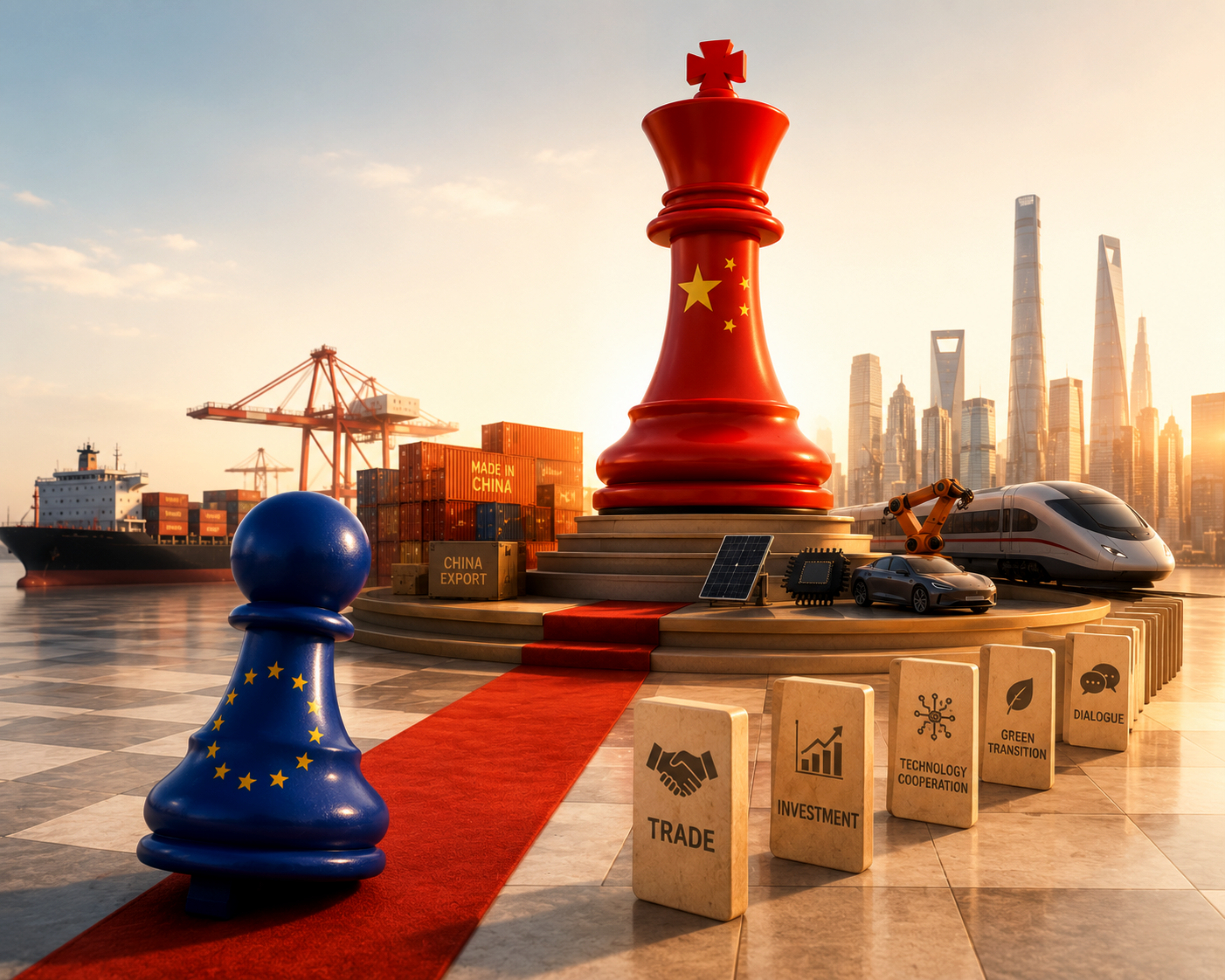
By 2036, Europe’s economic growth, industrial competitiveness and green transition are structurally dependent on China, while China’s exposure to Europe is limited and replaceable. Over 50–60% of Europe’s imports in critical sectors originate in China or rely on Chinese-controlled supply chains. The relationship is stable but asymmetrical, with China enjoying agenda-setting power and Europe relegated to constraint-based diplomacy in place of strategic autonomy. This is not full ‘vassalage,’ but a condition of high dependency with limited exit options.
European countries have no viable short-to-medium-term substitutes for China in multiple critical sectors. Attempting to replace them with European industries would incur high switching costs for European firms and governments. Dependence on China is moving beyond the trade-based system of 2026 to systemic and political alignment.
On the security front, Europe is no longer defining China as a direct military threat, as it did in 2026. Its concerns with China are reframed as risk management over the Taiwan Strait and jointly dealing with global stability challenges, while the US remains more inward-looking. Russia’s invasion to Ukraine ended in 2027 with Ukraine surrendering parts of its territory and NATO’s rhetoric on China has softened in response to influence from major EU member states. Europe now tolerates China’s continued strategic alignment with Russia, with minimal pressure imposed on Beijing.
On the diplomatic front, EU institutions’ statements on China are becoming more procedurally cautious and less critical of Beijing’s policies on human rights, ethnic minority groups and values. Many dialogues are now taking place through the UN and other multilateral forums, despite countries such as Czech Republic and Estonia continuing to hold highly critical views on China’s human rights record and political system.
European economic competitiveness
Throughout the workshop, all participants concurred that current debates in Europe on China are rooted in deep anxiety around Europe losing its economic competitiveness and political heft when dealing with Beijing.[3]
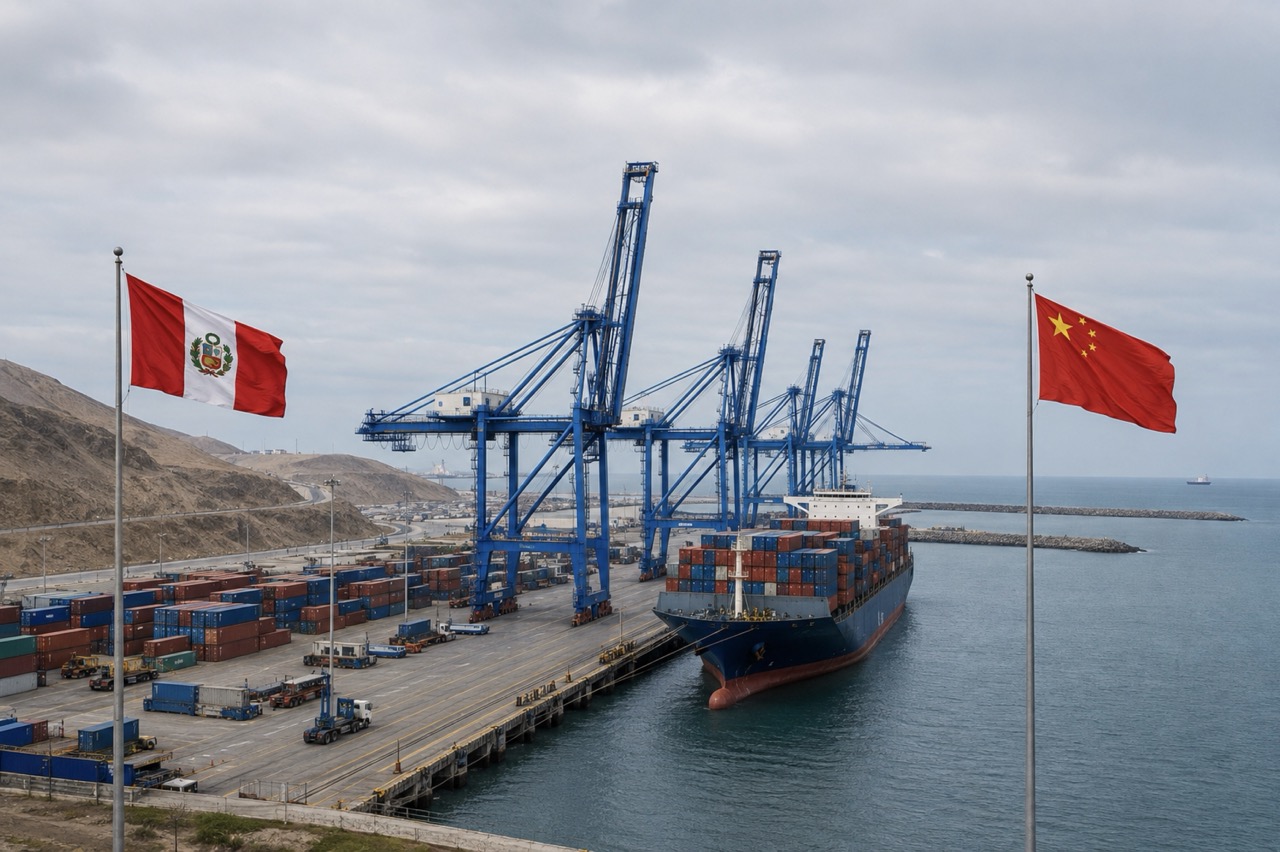
The scenario illustrates a transition from conventional economic interdependence to asymmetric dependence, in which European prosperity increasingly relies on Chinese technology, capital, intermediate goods and critical supply chains, while China's exposure to European markets has become comparatively limited and replaceable.
Many participants argued that the key mechanism driving this asymmetry will not be repeated economic coercion by China, but a gradual internalization of constraints by European political and business elites. Anticipation of economic vulnerability supplants external pressure, engendering self-limiting policy behaviour.
European firms no longer choose China because it is cheapest. They choose China because every alternative requires rebuilding supply chains that no longer exist.[4] This is a much deeper form of dependency.
This asymmetry substantially weakens Europe's strategic choices. The EU can import many goods from other countries while remaining competitive; problems begin when the costs of diversification become politically and economically prohibitive.
Rather than making commercial decisions based on price or efficiency alone, European governments and firms face impossibly high switching costs across multiple strategic sectors, including artificial intelligence, renewable technologies, pharmaceuticals and logistics. As a result, diversification is no longer merely expensive but politically and economically unfeasible in the medium term.
The scenario also implies a profound transformation of Europe's industrial ecosystem. Chinese firms are no longer external competitors but have become embedded in the European economy through manufacturing investment, infrastructure ownership and employment generation.
The emergence of companies such as BYD and CATL as major employers replacing traditional European industrial champions fundamentally alters domestic political incentives. As a result, Europe’s China policy extends beyond the realm of foreign affairs and economic security to become a key component of domestic politics.
Most EU national governments become subsequently reluctant to adopt policies that could jeopardize employment, regional investment or economic growth. Consequently, industrial competitiveness and strategic autonomy are increasingly difficult to reconcile. Rather than rebuilding indigenous technological capabilities, European economies adapt to a model in which Chinese firms constitute an integral component of their industrial development.
Psychological discomfort
Another interesting feature reflected among participants is a sense of psychological discomfort in imaging this 2036 scenario. The author deliberately designed an extreme but well-reasoned scenario, to prompt participants to think through hard choices. However, some participants contended that Europe is already committed to the path described in the scenario.
In addition to a shift in material capabilities and economic heft, the scenario illustrates a gradual psychological transformation among European political elites.[5] China's influence is exercised less through frequent economic coercion than through anticipatory compliance. A sense of anticipatory compliance reshapes the behaviour of both member states and EU institutions, encouraging procedural caution and diplomatic restraint, as policymakers internalize the expected costs of political confrontation and make decisions based on avoiding retaliation.
Participants debated how this anticipatory compliance would work in real life and suggested policymakers would endeavour to avoid this future for Europe. Some participants argued that such a scenario would severely limit Europe’s bargaining power with China and constrain Europe’s ability to act as both an economic heavyweight and an impactful geopolitical player.
Some participants predicted that sensitive issues such as human rights, ethnic minority policies and political values would become less significant than the existing economic and trade disputes with Beijing. European policymakers would increasingly define their priorities as preserving economic stability and minimizing disruption, rather than actively shaping China's external behaviour.
Some suggested that normative issues will migrate from EU-China diplomacy to multilateral forums, such as UN agencies, where criticism becomes less direct and less politically costly. This represents a shift in strategic culture rather than simply a tactical adjustment, with considerably less explicit resistance to China over its approach to normative issues such as human rights.
Such developments may also generate a gradual erosion of confidence in Europe's strategic agency. Repeated experiences of unsuccessful diversification efforts, widening technological gaps and diminishing leverage over Beijing will encourage policymakers to perceive structural dependence as a permanent condition rather than a temporary policy failure.
Over time, the central policy question evolves from how Europe can reduce dependence on China to how its dependence can be managed most effectively. This narrowing of strategic imagination does not necessarily imply ideological alignment with Beijing, but rather reflects a pragmatic adaptation to perceived structural constraints.
Policy ambition becomes increasingly bounded by assumptions regarding China's indispensable economic role in the European economy, reducing the willingness of European institutions to pursue policies that could fundamentally alter the existing relationship.
A similar psychological adjustment emerges within the European business community. Firms increasingly perceive deteriorating political relations with China as a greater commercial risk than regulatory uncertainty within Europe itself.
Corporate lobbying therefore shifts from advocating strategic resilience towards promoting stable and predictable bilateral relations. As investment decisions, research partnerships and long-term industrial planning become increasingly integrated with Chinese technological ecosystems, business preferences reinforce governmental caution. The resulting alignment between political and commercial interests further entrenches the structural dependence, making future diversification progressively more difficult and costly.
Global power shift
From a global power perspective, some participants argued that the scenario illustrates the emergence of an increasingly hierarchical international system, rather than the balanced multipolar order which Beijing has advocated in its diplomatic rhetoric.[6] China and the United States would remain the principal superpowers, while Europe's ability to operate as an autonomous geopolitical pole is gradually diminished.
China's influence derives not primarily from coercive measures, but from its capacity to shape the strategic calculations of others, as Beijing arguably learnt from Washington.[7] The accumulated economic asymmetry awards Beijing agenda-setting power, as European policymakers moderate their own behaviour in anticipation of economic consequences rather than in response to explicit threats. This represents a qualitatively deeper form of influence as policy restraint becomes internally generated rather than externally imposed.
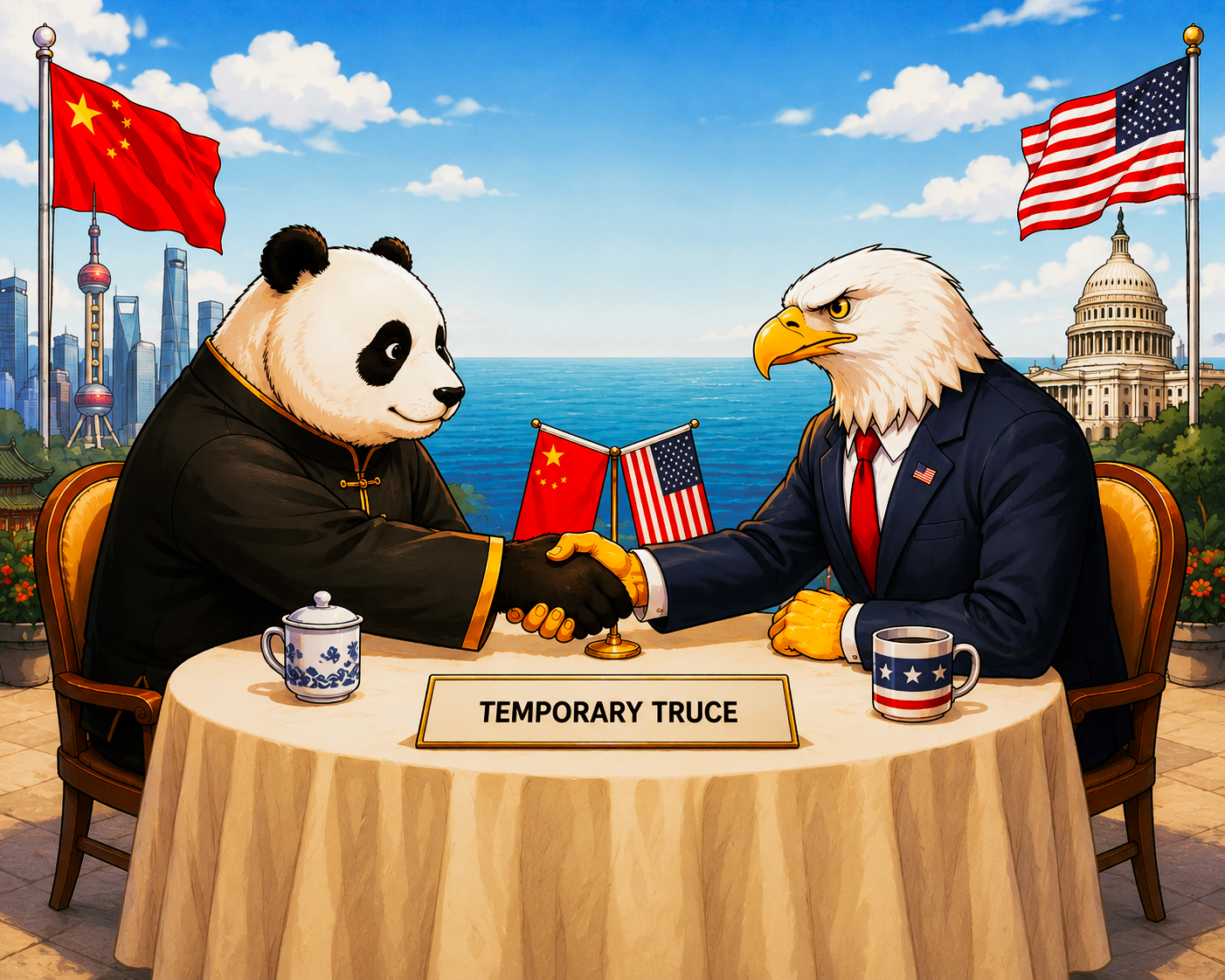
The implications extend beyond Europe–China relations to the broader transatlantic partnership. For years, across successive US administrations, Beijing has sought to capitalize on divisions between Europe and the United States. However, some Chinese strategists argue that transatlantic disputes represent tactical differences rather than a fundamental strategic divide. From this perspective, the challenges China faces with Europe and the US are primarily characterized by more enduring rivalries rooted in fundamentally different political systems.[8]
Some participants contended that Europe's reluctance to commit to coordinated sanctions or deterrence measures in answer to potential military escalation across the Taiwan Strait has weakened the credibility of collective Western responses. Under the Biden Administration, there was a sustained effort to build a united front against China over hi-tech export control, maritime security and issues over human rights.[9]
Other participants argued that, rather than aligning unequivocally with either Washington or Beijing, Europe will position itself as a mediator seeking stability and risk management. While this approach may reduce immediate economic vulnerability, it simultaneously reflects a reduction in Europe’s capacity to independently shape the strategic environment. In this scenario, Europe's international influence is derived from its ability to manage dependence in an international order increasingly structured by competition between the world's two leading powers.
Conclusion
The defining characteristic of the 2036 scenario envisioned in the workshop is not China's growing ability to coerce Europe, but Europe's unwillingness and inability to exercise strategic choice. As asymmetric interdependence deepens across critical industries, technology, infrastructure and investment, the anticipation of economic disruption becomes sufficient to shape European behaviour without Beijing calling for the application of coercive measures. Strategic restraint is no longer imposed externally; it is gradually internalized by European governments, businesses and institutions as the rational response to the existing structural dependence.
This transformation fundamentally alters the nature of Europe's relationship with China. Economic interdependence ceases to be a source of disputes and instead becomes a source of asymmetric influence. Although the EU remains institutionally intact and economically prosperous, its capacity to pursue strategic autonomy is constrained by the high political and economic costs of disengagement with Beijing.
National governments prioritize domestic economic stability over collective European action, while businesses reinforce this trajectory through investment decisions and lobbying preferences. Some of these debates and policy choices have already shaped individual EU member states’ attitude to China today.
More broadly, the scenario suggests that power in the international system is demonstrated not only through economic capabilities or explicit coercion in economic and military terms, but also through shaping the expectations and strategic calculations of others.
China's greatest advantage is therefore not its ability to retaliate against Europe, but its ability to make retaliation largely unnecessary. As European policymakers and industries consistently anticipate the costs of challenging Beijing, policy adjustment becomes routine and self-generated. Influence is applied through expectation rather than intervention.
The scenario does not portray Europe as a passive victim. Rather, it illustrates European countries making uneasy choices under increasingly restrictive structural conditions. Yet these individual choices collectively narrow Europe's path to long-advocated strategic autonomy. By 2036, the principal question is no longer whether Europe can reduce its dependence on China, but whether it still equipped with the political, economic and institutional capacity to imagine a credible alternative. In this sense, the most consequential loss is not economic leverage alone, but vanishing confidence in Europe's own strategic agency.

 | Co-funded by the European Union. Views and opinions expressed are however those of the author(s) only and do not necessarily reflect those of the European Union or European Research Executive Agency (REA). Neither the European Union nor the granting authority can be held responsible for them. |
| UK participants in Horizon Europe Project European Hub for Contemporary China are supported by UKRI grant numbers 10108183 and 10108749. |
[1] The “European Hub for Contemporary China (EuroHub4Sino)” project involved six cross-continent research institutions working to enhance Europe’s knowledge on contemporary China and has received funding from the European Union’s Horizon Europe reforming and enhancing the European R&I System programme under grant agreement number 101131737.
[2] Everts, S. (2026), ‘Europe must really confront China now: delay is no longer an option’, European Union Institute for Security Studies, 2 July 2026, https://www.iss.europa.eu/publications/commentary/europe-must-really-confront-china-now-delay-no-longer-option.
[3] Yu, J. (2025), ‘China–EU summit is unlikely to improve relations amid key differences on trade and Ukraine war’, Chatham House Expert Comment, 24 July 2025, https://www.chathamhouse.org/2025/07/china-eu-summit-unlikely-improve-relations-amid-key-differences-trade-and-ukraine-war.
[4] Cheng, E. (2026), ‘European companies double down on China manufacturing despite EU de-risking push’, CNBC, 26 May 2026, https://www.cnbc.com/2026/05/27/european-companies-expand-china-supply-chains-automation-costs.html.
[5] Le Monde (2025), ‘Faced with China, Europe is weak’, 25 July 2025, https://www.lemonde.fr/en/opinion/article/2025/07/25/faced-with-china-europe-is-weak_6743708_23.html.
[6] The State Council, People’s Republic of China (2026), ‘Full text: more just and equitable global governance: China's principles, proposals and actions’, 17 June 2026, https://english.www.gov.cn/archive/whitepaper/202606/17/content_WS6a326192c6d00ca5f9a0bab7.html.
[7] Yu, J. (2025), ‘Three lessons China learned from the United States’, Foreign Policy, 11 December 2025, https://foreignpolicy.com/2025/12/11/lessons-china-learned-superpower.
[8] Yu, J. (2025), ‘Stalemate or a step ahead? How China manages relations with the EU and its member states in light of transatlantic frictions’, EuroHub4Sino Policy Paper Series, 4 August 2025, https://eh4s.eu/publication/stalemate-or-a-step-ahead-how-china-manages-relations-with-the-eu-and-its-member-states-in-light-of-transatlantic-frictions.
[9] The United States Senate Committee on Foreign Relations (2024), ‘One step forward, two steps back: a review of US-Europe cooperation on China’, 24 July 2024, https://www.foreign.senate.gov/imo/media/doc/risch_july_2024_one_step_forward_two_steps_back_a_review_of_useuropecooperationonchina.pdf.