
Key takeaways
- Western commentary often celebrates China’s green surge as proof of global climate leadership, but this narrative obscures deep structural problems and significant internal disparities.
- China’s new-energy industries are extensions of its long-standing investment-driven development model, which prioritizes GDP growth at all costs, exacerbating regional and social inequalities.
- The electric-vehicle (EV) sector reveals severe power imbalances across resource allocation and industry chains, shifting risks onto small suppliers and consumers.
- Amid economic stagnation, massive consumption-subsidy programs create a new green paradox: they boost short-term consumption that primarily benefits wealthier groups while potentially jeopardizing long-term decarbonization.
- Europe can support a more just transition in China by encouraging responsible Chinese investment, promoting high-standard recycling cooperations, and placing social equity at the center of climate cooperation.
Introduction
A major outcome of COP30, held in Brazil in November 2025, was the adoption of a just transition mechanism.[1] For the first time in the COP history, the concept of "justice" took a central role in climate negotiations.[2] According to the European Commission, this mechanism "could – and should – support the protection of workers and communities as countries shift to clean energy and a climate-resilient future".[3] Civil society organizations also hailed the agreement as "one of the strongest rights-based outcomes in the history of the UN climate negotiations"[4].
However, the justice discourse advanced at COP30, like much of the broader climate-justice discourse, remains overwhelmingly oriented toward inequalities between countries: wealthy industrialized states in the Global North versus poorer states in the Global South. This framing is understandable against the historical backdrop: Developed countries have emitted far more greenhouse gases over time and possess far greater capacity to mobilize climate resources. Additionally, focusing on Indigenous rights serves as an essential counterbalance to technocratic perspectives, bringing affected communities to the forefront of global climate governance.
Yet this global framing can obscure an equally urgent dimension of injustice: inequalities within societies. Economic, social, and regional disparities fundamentally shape who benefits from the transition to low-carbon development and who bears the burdens, whether from climate impacts or from the policies designed to mitigate them.
This oversight becomes especially salient in the case of China. In much of the Western climate policy debate, China is viewed as a monolithic entity: either as a global polluter responsible for excessive emissions or as a leader in green-technology driving worldwide decarbonization. Both views fail to recognize China's internal diversity and the significant inequalities embedded in its transition.
Many in the West perceives China's current path within a specific geopolitical framework: Since Donald Trump took office for a second term and withdrew the United States from international climate change efforts, allies like the European Union and various climate organizations feel deeply unsettled. Consequently, many have pinned their hopes on the Chinese state.[5]As one Foreign Policy analysis put it, "climate policy advocates have wasted no time in proclaiming China to be the world's last best hope for climate action".[6]
Throughout late 2024 and 2025, this expectation was reinforced by the narrative of China’s impressive industrial dominance. Drawing on Chinese official terminology, several climate policy analyses have celebrated China's so-called "new three" industries (solar photovoltaics, electric vehicles, and batteries), with the framing that clean technologies contribute to a record 10 percent of China's GDP in 2024.[7] Others highlight that China’s rapid expansion of renewable energy was the main driver of global growth in renewables, suggesting that China is experiencing a "growing-by-greening" dynamic in which economic growth and decarbonisation advance in tandem.[8] "Only China can now lead the world on climate"[9], concluded an opinion piece in the Financial Times, following a lengthy critique of the U.S. governmental inaction.
However, two problems underline this narrative. First, even if the United States retreats from its climate commitments, does this automatically position China as the global climate leader? Second, and more centrally for the analysis that follows, the enthusiastic celebration of China's "growing-by-greening" trajectory tends to focus only on the winners: a state capable of strategic industrial planning, companies achieving record sales and global market shares, and urban middle-class consumers adopting new technologies. What is much less discussed are the growing pains of this transition. Are its benefits justly distributed? Who absorbs the costs—financial, environmental, and health-related? Who pays for the winners' success, and who carries the economic and social risks? These questions are at the heart of climate justice within China, and they drive the analysis in the following text. The first section offers an overview of research on China’s internal climate inequality, followed by a case study on social disparities within the EV sector. The third section introduces a new green paradox arising from the government’s efforts to boost consumption, while the final section explores how the EU can adapt its cooperation with China through the lens of a just transition.
China's internal climate inequality – an overview
While Western climate-policy discussions have largely overlooked this topic, there has been a growing amount of research in recent years focusing on the internal stratification of China's green transition. Chinese researchers, in particular, often integrate carbon-emission data with socio-economic indicators such as GDP and Gini coefficients, along with nationally representative household survey data, to examine inequality patterns and their structural causes at a macro level. This section outlines two analytical perspectives: regional inequality and the household carbon-footprint divide.
The regional divide
Studies employing various methodological approaches consistently reveal the same dynamic: economically advanced coastal provinces are the main beneficiaries of low-carbon restructuring, while resource-dependent inland provinces are disproportionately burdened by the transition. China's "new three" industries are predominantly located in coastal provinces with robust innovation ecosystems, deep integration into global value chains, and high-tech manufacturing capabilities[10]. Furthermore, these advanced regions exploit a "siphoning effect" that enables them to draw in more green investment while outsourcing carbon-intensive activities to less developed provinces, thereby deepening their structural advantages within China's development model.[11]
In contrast, coal-dependent and heavy-industry provinces are experiencing structural decline, facing larger challenges of unemployment and shrinking local-government budgets. Paradoxically, some of these less affluent regions have higher per-capita carbon footprints than the wealthier coastal areas. As Tian et al. demonstrate, provinces like Qinghai or Inner Mongolia have elevated carbon footprints not due to household consumption patterns, but because of emissions related to capital formation associated with infrastructure projects and coal-based energy production[12]. This creates a developmental trap where low-income regions bear the heaviest carbon burdens yet lack the fiscal and technological resources needed for transition. These regional patterns are also evident at the municipal level. A study of 283 cities shows that energy-transition affordability (ETA) is significantly lower in western, resource-based cities compared to the coastal east.[13] The study further identifies strong path dependence, indicating that cities are highly likely to remain in their original state over time.
Inequality metrics mirror these findings. Between 2000 and 2021, Gini-based measures of inter-provincial carbon-footprint inequality rose significantly, largely driven by disparities in raw-coal and crude-oil emissions.[14] Collectively, these findings present a coherent and concerning picture: China's green transition is reinforcing, rather than alleviating, existing regional inequalities.
Household carbon stratification: the class and rural–urban divide
China's swift economic expansion in recent decades has significantly enhanced living conditions and boosted household consumption. However, this growth has also exacerbated wealth disparity and increased household carbon emissions. Research indicates that as early as 2012, the top 5% wealthiest households had per capita carbon emissions reached the level of the average European. From 2007 to 2012, overall household emissions in China rose by 19%, with 75% of this increase attributed to the consumption of the urban middle and upper class.[15]
A growing body of work shows that climate inequality within societies is a serious problem, including in high‑income countries, both in terms of who causes emissions and who bears impacts and policy costs.[16]For instance, the top 10% wealthiest households contribute about 3.1 times the average citizen's global warming impact in the United States, 2.8 times in the EU27, and roughly 4 times in China.[17] Recent studies confirm ongoing carbon inequality among Chinese social groups, with high-income households disproportionately contributing to national emissions. A 2025 analysis furthers this discussion by suggesting that capital disparity—rather than consumption alone—primarily drives carbon inequality in today's China[18]. As demonstrated in Figure 1, in most provinces, the middle and upper class dominate carbon emissions.

Figure 1: Per capita carbon footprints of 10 income groups in 29 provinces in China (2017).
Note: The figure is created from "China's current carbon inequality is 'predominantly determined by capital disparity'", by Tian et al, 2025.Copyright 2024 by Elsevier B.V. China's current carbon inequality is predominantly determined by capital disparity - ScienceDirect
The study also attributes this gap to lifestyle differences: wealthier households increasingly purchase carbon-intensive luxury items (high-end fashion, large homes, and private vehicles), while emissions from poorer households remain linked to basic needs like essential household equipment and services. In the rural sector, housing accounts for 53.70% of rural household carbon inequality. Within the housing category, home purchases (45.51%), heating (33.70%), and household electricity use (15.37%) are the largest contributors.[19]
A particularly telling example of rural–urban inequality represents the issue of winter heating in northern rural China. Many rural households still depend on coal or firewood, which not only increases emissions but also poses health risks. As one study notes, lagging gas and clean-energy infrastructure in poorer and rural areas leaves many residents unable to fully benefit from transition policies.[20]
Ironically, the government's "coal-to-electricity" and "coal-to-gas" initiatives have, in many instances, worsened rural hardship. In their quest for rapid emissions reductions, local governments often prohibited coal heating before establishing adequate electric or gas infrastructure. Additionally, electricity and gas are significantly more expensive than coal. As Goron et al. observe, "the fuel switch has resulted in rural households paying a much higher incremental energy cost than their urban counterparts, in some cases possibly rising to over 15% of their disposable income"[21]. Consequently, adopting clean heating has become disproportionately burdensome and less advantageous for low-income rural residents.
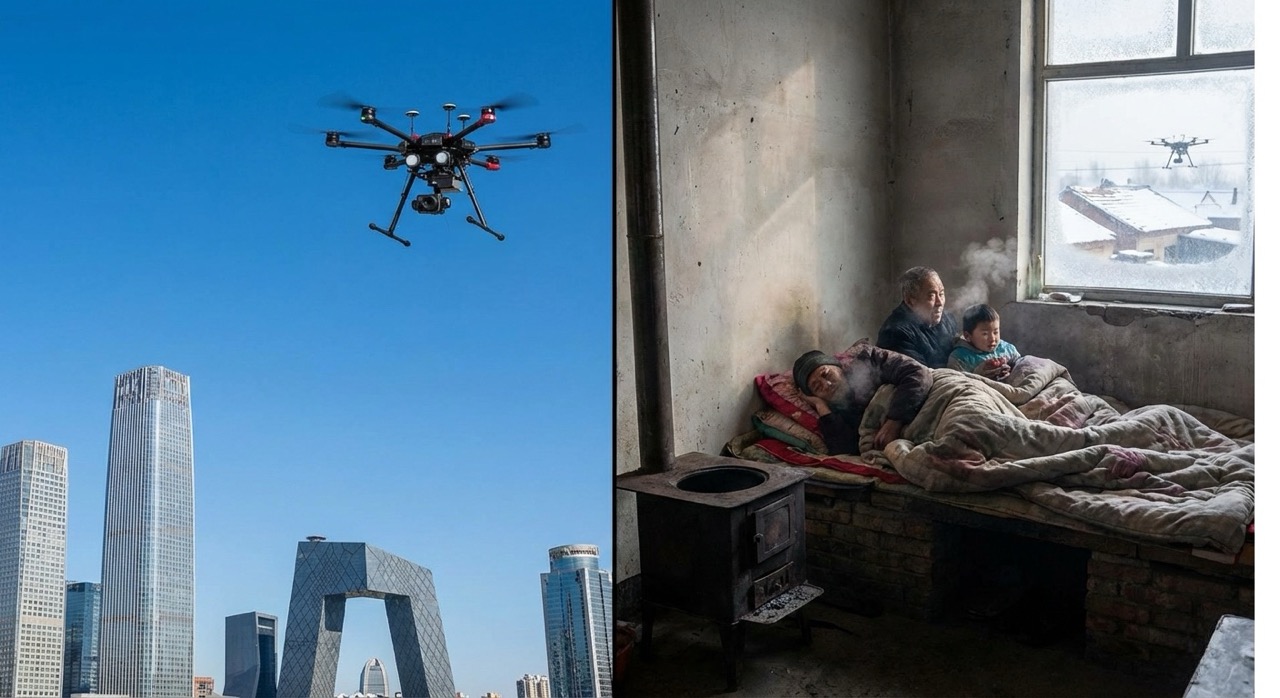
Each winter, media outlets report instances of rural families left without sufficient heating due to strict enforcement of clean-energy mandates. At the start of 2026, reports emerged that local authorities in neighbouring Hebei province, seeking to safeguard Beijing’s blue skies, deployed drones to patrol villages and prevent farmers from burning coal for warmth.Because many residents cannot afford gas heating (gas costs 20–30% more in Hebei than in Beijing), they are forced to endure the cold.[22] The stark contrast between high-tech surveillance and rural poverty has ignited a firestorm on social media.
Case study: the hidden cost of China's EV-expansion
Western climate advocates often praise China's rapid EV expansion as evidence of Beijing's commitment to global decarbonization. In contrast, European policymakers worry that an influx of low-cost Chinese EVs could undermine domestic industries. Both reactions overlook a deeper structural explanation: China's EV boom is not a new phenomenon but a continuation of the investment-driven "local developmentalism"[23] since the 1990s, revealing profound power asymmetries within the country's economic structure.
Involution, overcapacity, and Zombie firms
European concerns are not unfounded. China's EV sector has been caught in a cut-throat price war: between 2022 and 2024, average discounts of electric cars reached nearly 9 percent, with many companies selling vehicles below cost just to keep production lines running.[24] This dynamic exemplifies a Chinese buzzword "involution" (内卷): a relentless competition characterized by destructive price wars, product homogeneity, and improper business practices.[25]
What is the rationale behind this seemingly irrational market behavior? The answer lies in a political economy where regional governments compete aggressively for revenue and growth. As Su and Tao suggest[26], China's one-party state has granted the central government tremendous power to shape the fiscal system to its benefit. This setup has led to acute revenue shortages for local governments, forcing them to behave as "revenue maximizers". Local officials have been actively involved in expropriating land from farmers, developing industrial parks and infrastructure projects, and promoting residential and commercial real estate.
Following the collapse of China's property bubble in recent years, local governments, desperate to maintain GDP growth, pivoted to the EV sector, incentivizing manufacturers with cheap land, subsidies, and government-backed loans. This rush has led to massive overcapacity; by 2025, factory utilization rates dropped to nearly 50%, leaving half of production lines idle. In a functioning market, such inefficiencies would prompt consolidation or firm exit. However, within China's political economy, bankruptcy is often politically unacceptable. Local officials sustain "zombie companies" through credit rollovers to avoid the visible failure of industrial parks and the political consequences that follow.[27]
Despite central government rhetoric against "involutional competition" since 2025, analysts remain doubtful that this systemic overcapacity can be resolved, as long as the underlying power imbalances and fiscal incentives remain unchanged.[28] The outcome is a cycle of inflated GDP figures, rising local debt, and the depletion of public resources and environmental protections. Furthermore, this path exacerbates social inequality, as uneven resource distribution and the increasing oligopolization of strategic sectors widen income disparities and hinder social mobility.[29]
Who pays the winners' bill? Asymmetrical power in the industry chain
The social stratification inherent in China's EV industry is especially evident in the power imbalance between large national champions and smaller suppliers. While firms such as BYD are celebrated globally, their success is partly built upon structural advantages, and structural vulnerabilities, within the domestic industrial system. As China’s flagship EV producer, BYD is deeply intertwined with government support. In 2024, the company received more than 14 billion yuan (roughly USD 2 billion) in government subsidies, accounting for around 35% of its net profit and doubling the figure from 2023.[30]
What is less apparent is how BYD manages its relationships with its more than 8,000 suppliers, particularly through a financial tool known as a 'quasi-bill'. Functionally as a form of IOU, a quasi-bill allows BYD to delay cash payments by issuing a promise to pay at a future date. Suppliers who require liquidity must take these notes to banks and discount them, effectively paying 5–7% interest simply to access revenues they have already earned. In effect, BYD retains its cash longer, boosting its own financial statements, while the smaller, often marginally profitable suppliers (operating on thin profit margins typically ranging from 2 to 10 percent) carry the cost.[31]
According to Chinese media Caixin, the accounts payable of BYD have seen a rapid increase from 22.52 billion yuan in 2019 to more than 237 billion yuan in 2024, a tenfold increase, while its revenues only tripled over the same period.[32] This unequal power dynamic is further compounded by extreme demands; for instance, in 2025, BYD reportedly demanded an additional 10 percent price cut from its partners, pushing many smaller firms to the brink of survival.
Consumer as the risk-bearing class: asymmetrical power in the market
While China's electric vehicle (EV) expansion is frequently attributed to state industrial policy and manufacturing strength of domestic firms, the decisive agency of over ten million annual consumers is often understated. Crucially, the motivations driving this consumption differ significantly from Western environmentalist assumptions. Empirical research shows that climate awareness is not a primary determinant for Chinese buyers.[33] Instead, purchasing decisions are heavily influenced by a demand for "smart" features and digital connectivity.[34] A McKinsey survey underscores this difference: whereas German consumers associate EV connectivity with traditional comforts such as heated seats and parking assistance, Chinese users prioritize smartphone integration and "full autonomous driving" capabilities.[35]
In China, autonomous driving is widely perceived as the cutting edge of mobility, a view actively reinforced by state industrial policy. The 2015 "Made in China 2025" plan explicitly set the goal of establishing a "self-sufficient intelligent-vehicle industry chain", designating "fully autonomous vehicles" as key products.[36] The regulatory environment has been tailored to this ambition: When the German BMW launched its autonomous-driving tests in Shanghai in 2018, executives reportedly remarked to Chancellor Angela Merkel that the company was expanding its R&D in China due to the "more conducive conditions and less red tape" compared to Germany.[37] Yet while China's regulatory framework is strongly oriented toward supply-side innovation, consumer protection remains weak, producing a structural power imbalance between dominant brands and individual buyers.
This asymmetry was made visible in a fatal crash of a Xiaomi SU7 in Anhui in March 2025, which resulted in the deaths of three female university students. Despite public scrutiny regarding the aggressive marketing of Xiaomi's "self-driving" capabilities, official regulatory responses were muted, and the company swiftly reclassified the system as a basic driver-assistance function. Corporate public-relations efforts and legal resources frequently shift accountability onto consumers. Following the Anhui incident, online discourse devolved into victim-blaming, with some commentators directing sexist insinuations at the victims.[38] As the South China Morning Post reported, analysts argued that "millions of drivers need to be educated"[39], framing the issue as user ignorance rather than technological failure or regulatory gaps.
This pattern persisted: In October 2025, when another fatal Xiaomi incident occurred, the driver was once again blamed online, while many media outlets avoided naming the manufacturer.[40]
Intriguingly, the state's approach to safety regulations further highlights social disparity. While high-tech EV manufacturers enjoy a relatively permissive regulatory framework, safety interventions in the grassroots mobility sector often manifest as punitive actions that overlook user needs.
On December 1, 2025, China introduced new safety standards for e-bikes, a transportation mode utilized by 380 million people. Although these regulations aim to reduce traffic accidents and battery fires, they have sparked overwhelming public backlash. The rules limit rear seating, decrease storage space, and push the cost of standard models from about 2,000 to 3,000 yuan (from roughly €240 to €363).[41] Critics argue that these changes undermine essential mobility functions such as transporting children, daily commuting, and threaten the livelihoods of 20 million food delivery workers. Many suspect that the policy indirectly benefits the EV industry by making e-bikes less practical. However, as one online commentary points out: "Not every family can afford to buy or maintain a car, and in densely populated cities, commuting by bus or subway is a physical battle. The advantage of the e-bike lies precisely in its flexibility".[42] Media outlets also call on policymakers to "balance safety, cost, practicality, and regulation" to create a truly fair mobility system.[43]
Essentially, Chinese consumers find themselves in a vulnerable position as a "risk-bearing class". In the high-end market, they support technological advancements at the expense of their own safety; in the low-end market, they either compromise their safety for affordable mobility or bear the financial burden of regulatory compliance. The human cost of China's mobility transition is disproportionately borne by individual consumers.
China's green paradox: consumption vs. decarbonization
The upgrading and replacement of e-bikes should be understood as part of a broader set of government initiatives aimed at stimulating domestic consumption. China is entering a prolonged phase of economic deceleration rooted in structural imbalances accumulated over several decades. Since 2021, falling housing prices have sharply eroded household wealth, as over 70% of which is tied to property assets.[44] Coupled with geopolitical tensions, high youth unemployment, and weakening private-sector confidence, these factors have suppressed domestic consumption, creating a deflationary trap that Beijing can no longer ignore.
The regressive nature of demand-side stimulus
To counter this, the central government designated 2024 as the "Year of Consumption Promotion", launching a sequence of large-scale consumption-subsidy programs worth hundreds of billions of yuan. These measures, framed as "green upgrades" and "energy-efficiency trade-ins"[45], encourage households to replace older appliances, vehicles, and interior furnishings with newer, cleaner, "smarter" models. Tellingly, the subsidies apply not only to EVs but also to internal-combustion cars. In 2025, the scope of subsidies expanded into services consumption and broader categories of high-end products. Five of China's most wealthy cities: Beijing, Shanghai, Guangzhou, Tianjin, and Chongqing—were designated as priority beneficiaries, each receiving 200 million yuan in central-government support for consumption promotion.
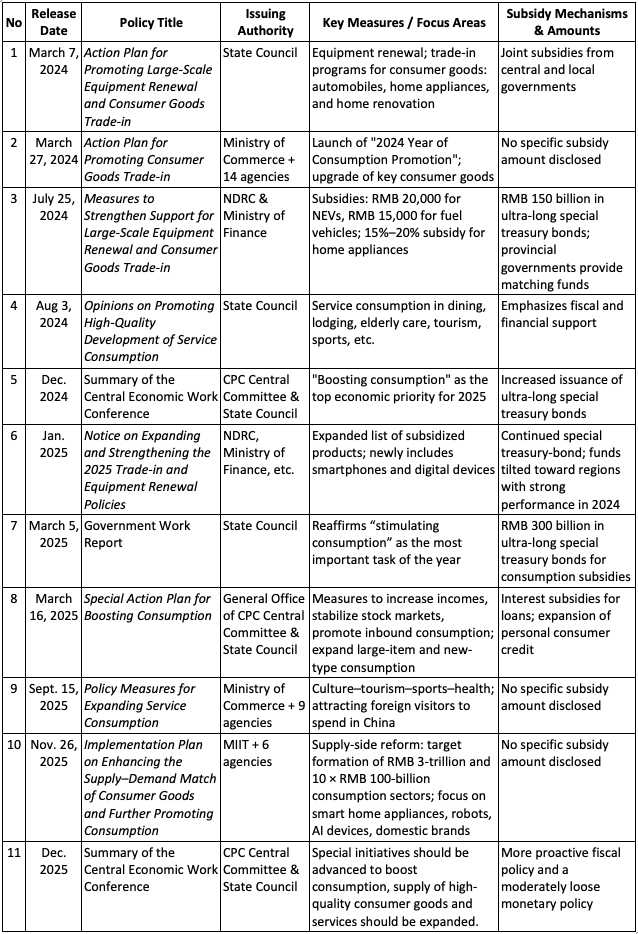
Table 1: China's 2024–2025 Consumption-Stimulus and Trade-in Policies
Source: Own compilation.
However, these demand-side interventions exhibit regressive distributional effects: because the programs require substantial upfront spending and often target high-value goods, the benefits disproportionately accrue to urban middle- and upper-income households, leaving lower-income groups behind. As Cui Dongshu, Secretary-General of the China Passenger Car Association, noted in 2025, vehicle subsidies "failed to reach those who need them most", instead favoring wealthier families trading in their second or third cars.[46]
Nevertheless, the government's November 2025 Implementation Plan for Further Promoting Consumption[47] explicitly prioritizes high-end, technology-intensive products: "smart home appliances, wearable devices, humanoid robots, and drones", identifying these categories as future "trillion-yuan markets". The plan further emphasizes accelerating "AI + consumption" as the next frontier of domestic demand. Reflecting this policy orientation, the government highlights the rapid growth of these sectors: in 2025, output of smart drones increased by 59.9 % year-on-year, while vehicles equipped with L2-level autonomous-driving features reached a penetration rate of 64%.
AI as an emerging driver of climate inequality
The rapid expansion of artificial intelligence (AI) introduces a new and insufficiently studied dimension of China’s climate challenge. The United Nations Environment Programme has warned that AI surge causes substantial energy consumption, greenhouse gas emissions, water use for cooling, and growing volumes of electronic waste.[48] In 2024, data centers accounted for 1.5 percent of global electricity demand, with the United States responsible for the largest share (45 percent), followed by China (25 percent) and Europe (15 percent).[49] Recent modelling[50] indicates that the electricity consumption of AI data centers in China alone could surpass 1000 TWh by 2030, placing immense pressure on the national power system and driving a significant increase in emissions.
This dynamic is actively reinforcing a new form of internal climate inequality. The primary economic gains of the AI boom: high-income employment, productivity boosts, and consumer upgrades, are concentrated in already prosperous eastern coastal provinces. In contrast, poorer inland and western regions bear a disproportionate burden: Since 2022, the Chinese government has launched the Eastern Data, Western Computing initiative, establishing national computing hubs in Inner Mongolia, Guizhou, Gansu, and Ningxia to process data generated by eastern provinces;[51] this has posed significant water-use challenges for Western regions, which still rely heavily on coal.
Ultimately, China is facing a green paradox: the very policies necessary to stimulate domestic demand is driving a consumption model that risks undermining long-term decarbonization goals and deepening internal inequality. Addressing this requires moving beyond subsidy-driven "growth at any cost" toward a model that integrates social equity with genuine sustainability.
Conclusion: toward a just and sustainable EU-China climate partnership
The emphasis on "Just Transition" principles at COP30 offers an important opportunity for the European Union to recalibrate its climate cooperation framework with China. To do so, the first step for the EU is to move beyond the dominant technocratic viewpoint, which frequently highlights sensational production figures and low costs, such as the portrayal of Chinese "cheap clean tech"[52] and "green overcapacity" as the "solution the world asked for"[53], while obscuring the significant social and human costs behind these numbers. As previously discussed, China's current green overcapacity is not a global remedy but rather a symptom of an unsustainable development model marked by social inequality and inefficient allocation of financial and environmental resources—problems that even Beijing now seeks to resolve.
Rather than endorsing a paradigm of "growth at any cost", the EU should capitalize on its comparative advantages, particularly in energy efficiency, sustainable consumption, social inclusion, and broad stakeholder consultation. These experiences enable Europe to make a significant contribution to China's next phase of transition, aiding in shifting the focus from rapid industrial growth to long-term social and environmental resilience.
Another strategic approach is for the EU to encourage regulated Chinese outbound investment into Europe. Analyses indicate that relocating segments of China's overcapacity to overseas production is among the most feasible mechanisms for reducing domestic saturation while reducing geopolitical frictions. Overseas manufacture would allow Chinese firms to maintain demand for intermediate goods while avoiding trade disputes and contributing to employment and technology transfer in host economies.[54] This trajectory mirrors developmental stages of Japan, South Korea, and Taiwan, whose firms internationalized during their industrial maturation. Many Chinese manufacturers, strained by intense "race to the bottom" competition at home, are seeking such opportunities. For Europe, welcoming these investments could enhance industrial capacity, create jobs, foster new supply chains, and acquire technology—provided that social and environmental standards are strictly maintained. Therefore, the EU must establish early and ongoing engagement frameworks: communication channels, compliance training, and monitoring systems to ensure that incoming firms adhere to European norms from the beginning.
Finally, the EU must address the environmental and social risks embedded in China's green-technology sectors, particularly photovoltaic and battery manufacturing. China's green industries emerged in the 2000s under the developmental logic of "pollute first, clean up later", leading to severe pollution and hazardous working conditions. The country now faces a massive wave of end-of-life clean-tech waste: the International Energy Agency projects that China will generate 1.7 million tons of retired PV modules by 2030,[55] and battery retirement is expected to surge beginning in 2026. Yet approximately 70% of used EV batteries currently flow into informal recycling channels, which expose workers to toxic substances and release harmful pollutants into soil and air.[56]
A similar issue exists with PV module recycling: although China's Pre-2030 Carbon Peaking Action Plan officially advocates for the development of recycling systems for batteries and PV modules,[57] the country still lacks a comprehensive regulatory framework akin to the EU's WEEE Directive. Informal operators, often based in rural areas with minimal oversight, use primitive methods to burn or dismantle components, causing significant ecological damage and achieving low material recovery rates.
In this scenario, the EU should focus on creating strategies to collaborate with China on green-waste recycling, including establishing industry standards and circular-economy models, to help prevent another wave of ecological injustice in China's "growing-by-greening" process. By promoting responsible waste management, the EU can aid in a truly sustainable and socially equitable global energy transition.

 | Funded by the European Union. Views and opinions expressed are however those of the author(s) only and do not necessarily reflect those of the European Union or European Research Executive Agency (REA). Neither the European Union nor the granting authority can be held responsible for them. |
[1] UNFCCC (2025). Outcomes Report of the Global Climate Action Agenda at COP 30. https://unfccc.int/documents/655037. Last accessed 17 January 2025.
[2] Carbon Brief (2025). COP30: Key outcomes agreed at the UN climate talks in Belém. https://www.carbonbrief.org/cop30-key-outcomes-agreed-at-the-un-climate-talks-in-belem/. Last accessed 17 January 2025.
[3] Directorate-General for Climate Action, European Commission (2025). What did COP30 achieve? https://climate.ec.europa.eu/news-other-reads/news/what-did-cop30-achieve-2025-12-01_en. Last accessed 17 January 2025.
[4] Climate Action Network International (2025.). Just Transition Rising. https://climatenetwork.org/updates/event-portal/just-transition-rising/. Last accessed 17 January 2025.
[5] See, for example: Sun, Yixian (2025). The world needs climate change leadership – it's time for China to step up. The Conversation. https://theconversation.com/the-world-needs-climate-change-leadership-its-time-for-china-to-step-up-252698. Last accessed 17 January 2025. You, Xiaoying (2025). Can China fill the vacuum in climate leadership? Reuters. https://www.reuters.com/sustainability/climate-energy/can-china-fill-vacuum-climate-leadership--ecmii-2025-11-04/. Last accessed 17 January 2025. Young, Holly (2024). Will China become a leader in global climate action? Deutsche Welle. https://www.dw.com/en/will-china-replace-us-as-leader-in-global-climate-action/a-70839105. Last accessed 17 January 2025.
[6] Wang, Server (2025). China Is No Climate Savior. Foreign Policy. https://foreignpolicy.com/2025/03/20/china-climate-emissions-renewable-energy-solar-coal-trump/. Last accessed 17 January 2025.
[7] Myllyvirta, Lauri (2024). Analysis: Clean energy contributed a record 10% of China’s GDP in 2024. Centre for Research on Energy and Clean Air. https://energyandcleanair.org/analysis-clean-energy-contributed-a-record-10-of-chinas-gdp-in-2024/
[8] Yang, Muyi, Shi, Xunpeng, Yang, Biqing(2025). Powering China’s New Era of Green Electrification. Ember. https://ember-energy.org/app/uploads/2025/05/Report-Powering-Chinas-New-Era-of-Green-Electrification-PDF.pdf. Last accessed 17 January 2025.
[9] Tooze, Adam (2024). Only China can now lead the world on climate. Financial Times. https://www.ft.com/content/fe397ced-432c-430f-b6e4-336ba5084e5b. Last accessed 17 January 2025.
[10]Goron, Coraline; Zhang, Junjie (2023). Pathways towards a just transition to carbon neutrality in China. Friedrich Ebert Stiftung.https://china.fes.de/e/publication-pathways-towards-a-just-transition-to-carbon-neutrality-in-china.html . Last accessed 17 January 2025.
[11]Liu, Y.; Deng, L.(2024). Mapping carbon emission networks in China: insights from province-level spatial differentiation. Carbon Footprints 2024, 3, 18. http://dx.doi.org/10.20517/cf.2024.26. Last accessed 17 January 2025.
[12]Tian, P., Ma, H., Zhang, Z., Yu, Y., & Li, D. (2025). China's current carbon inequality is predominantly determined by capital disparity. Ecological Economics, 230, 108515.
[13] An, C., & Zhou, P. (2024). Energy transition affordability in China: Disparities and determinants. Energy Economics, 140,https://www.sciencedirect.com/science/article/abs/pii/S0140988324006807. Last accessed 17 January 2025.
[14] Liu, Y.; Deng, L.(2024). Mapping carbon emission networks in China: insights from province-level spatial differentiation. Carbon Footprints 2024, 3, 18. http://dx.doi.org/10.20517/cf.2024.26. Last accessed 17 January 2025.
[15]Wiedenhofer, D., Guan, D., Liu, Z., Meng, J., Zhang, N., & Wei, Y. M. (2017). Unequal household carbon footprints in China. Nature Climate Change, 7(1), 75-80.
[16] See for example: Chancel, L.; Bothe, P.; Voituriez, T. (2023). Climate Inequality Report 2023. World Inequality Lab. https://wid.world/www-site/uploads/2023/01/CBV2023-ClimateInequalityReport-1.pdf. Last accessed 17 January 2025; Schöngart, S., Nicholls, Z., Hoffmann, R., Pelz, S., & Schleussner, C. F. (2025). High-income groups disproportionately contribute to climate extremes worldwide. Nature Climate Change, 1-7. Mumtaz, H., & Theophilopoulou, A. (2024). The distributional effects of climate change. An empirical analysis. European Economic Review, 169, 104828.
[17] Schöngart, S., Nicholls, Z., Hoffmann, R. et al. (2025. High-income groups disproportionately contribute to climate extremes worldwide. Nat. Clim. Chang. 15, 627–633. https://doi.org/10.1038/s41558-025-02325-x.
[18] Tian, P., Ma, H., Zhang, Z., Yu, Y., & Li, D. (2025). China's current carbon inequality is predominantly determined by capital disparity. Ecological Economics, 230, 108515.
[19] Sun, M., Chen, G., Xu, X., Zhang, L., Hubacek, K., & Wang, Y. (2021). Reducing carbon footprint inequality of household consumption in rural areas: analysis from five representative provinces in China. Environmental science & technology, 55(17), 11511-11520.
[20] Wu, L., Liu, Q., & Li, L. (2024). Can the household clean energy transition ameliorate health inequality? Evidence from China. Frontiers in Public Health, 12, 1348234.
[21] Goron, Coraline; Zhang, Junjie (2023). Pathways towards a just transition to carbon neutrality in China. Friedrich Ebert Stiftung.https://china.fes.de/e/publication-pathways-towards-a-just-transition-to-carbon-neutrality-in-china.html . Last accessed 17 January 2025.p.2.
[22] Gu, Xun (2026). "煤改气"后的农村取暖困境 [The rural heating dilemma after "coal-to-gas" conversion]. Sanlian Lifeweek. https://www.lifeweek.com.cn/article/260639. Last accessed 17 January 2026.
[23] Su, F., & Tao, R. (2015). The China model withering? Institutional roots of China’s local developmentalism. Urban Studies, 54(1), 230-250.
[24] Hou, Qijiang (2025). Will China’s Electric Vehicle Industry Face Its Own Evergrande Moment? Echowall. https://www.echo-wall.eu/off/will-chinas-electric-vehicle-industry-face-its-own-evergrande-moment. Last accessed 17 January 2025.
[25]See, also: Shaun Breslin (2025). What’s Rational For The National And What’s Focal For The Local? Towards A “Unified National Economy”? EuroHub4Sino. https://eh4s.eu/publication/whats-rational-for-the-national-and-whats-focal-for-the-local-towards-a-unified-national-economy#_ftn2. Last accessed 17 January 2025; Pettis, Michael (2025). What’s New about Involution? Carnegie Endowment for International Peace. https://carnegieendowment.org/posts/2025/08/whats-new-about-involution?lang=en. Last accessed 17 January 2025.
[26] Su, F., & Tao, R. (2015). The China model withering? Institutional roots of China’s local developmentalism. Urban Studies, 54(1), 230-250.
[27] Hou, Qijiang (2025). Will China’s Electric Vehicle Industry Face Its Own Evergrande Moment? Echowall. https://www.echo-wall.eu/off/will-chinas-electric-vehicle-industry-face-its-own-evergrande-moment. Last accessed 17 January 2025.
[28] See, for example: Pettis, Michael (2025). What’s New about Involution? Carnegie Endowment for International Peace. https://carnegieendowment.org/posts/2025/08/whats-new-about-involution?lang=en; Lee, Lizzi C. (2025) The China Model’s Fatal Flaw. Why Beijing Can’t Overcome Overcapacity. Foreign Affairs. https://www.foreignaffairs.com/china/china-models-fatal-flaw-lizzi-lee; Breslin, Shaun (2025). What’s Rational For The National And What’s Focal For The Local? Towards A “Unified National Economy”? EuroHub4Sino. https://eh4s.eu/publication/whats-rational-for-the-national-and-whats-focal-for-the-local-towards-a-unified-national-economy#_ftn2. Last accessed 17 January 2026.
[29] KWAN, Chi Hung (2025). “Involutional Competition” Leading to Oversupply in China. Research Institute of Economy, Trade and Industry. https://www.rieti.go.jp/en/china/25082501.html. Last accessed 17 January 2025.
[30] Chen, Rui (2025). 比亚迪获补助104亿占净利35%,经营活动现金流降逾21% [BYD receives 10.4 billion yuan in subsidies, accounting for 35% of net profit; operating cash flow drops over 21%]. OFweek. https://nev.ofweek.com/2025-03/ART-71000-8110-30660144.html . Last accessed 17 January 2025.
[31] Hou, Qijiang (2025). Will China’s Electric Vehicle Industry Face Its Own Evergrande Moment? Echowall. https://www.echo-wall.eu/off/will-chinas-electric-vehicle-industry-face-its-own-evergrande-moment. Last accessed 17 January 2025.
[32] Zhang, Yuzhe & Zhu, Liangtao (2025). 万亿“类票据”野蛮生长大企业信用过度扩张有何危害 [The wild growth of trillion-dollar “quasi-bills”: The risks of excessive credit expansion by large corporations]. Caixin Weekly. https://database.caixin.com/2025-03-01/102293336.html. Last accessed 17 January 2026.
[33] Du, H., Liu, D., Sovacool, B. K., Wang, Y., Ma, S., & Li, R. Y. M. (2018). Who buys New Energy Vehicles in China? Assessing social-psychological predictors of purchasing awareness, intention, and policy. Transportation Research Part F: Traffic Psychology and Behaviour, 58, 56-69; Dai, G., & Yang, S. (2024). A comparative study of motivations driving EV purchases in different-tier Chinese cities. Transportation Research Part D: Transport and Environment, 126, 103993.
[34] Zhu, Yi (2021). A tale of two e-mobilities. Echowall. https://www.echo-wall.eu/inside-china/off/tale-two-e-mobilities. Last accessed 17 January 2025.
[35] McKinsey & Company (2024). Car connectivity: What consumers want and are willing to pay. https://www.mckinsey.com/industries/automotive-and-assembly/our-insights/car-connectivity-what-consumers-want-and-are-willing-to-pay. Last accessed 17 January 2025.
[36] National Manufacturing Strategy Advisory Committee. (2015). 《中国制造2025》重点领域技术路线图 [Technology roadmap for key areas of Made in China 2025]. https://www.cae.cn/cae/html/files/2015-10/29/20151029105822561730637.pdf. Last accessed 17 January 2025.
[37]Zhu, Yi (2021). A tale of two e-mobilities. Echowall. https://www.echo-wall.eu/inside-china/off/tale-two-e-mobilities. Last accessed 17 January 2025.
[38]Hou, Qijiang (2025). Will China’s Electric Vehicle Industry Face Its Own Evergrande Moment? Echowall. https://www.echo-wall.eu/off/will-chinas-electric-vehicle-industry-face-its-own-evergrande-moment. Last accessed 17 January 2025.
[39] Ren, D. & Xue, Y.‘Millions of drivers need to be educated’ in wake of fatal Xiaomi crash, analysts say. South China Moring Post. https://www.scmp.com/business/china-business/article/3304885/millions-drivers-need-be-educated-wake-fatal-xiaomi-crash-analysts-say. Last accessed 17 January 2025.
[40] NetEase (2025). 成都小米汽车起火事件,满屏的热搜却连品牌都不敢提 [Chengdu Xiaomi car fire incident: trending everywhere but no one dares mention the brand]. https://www.163.com/dy/article/KBOR0JPT0556CH8U.html. Last accessed 17 January 2025.
[41] Phoenix Finance (2025). 2000万外卖骑手,困在新国标电动车. [20 million food delivery couriers trapped by the new national standard for electric bikes]. https://finance.sina.com.cn/chanjing/2025-12-04/doc-infzsfyu8914228.shtml?cre=sinapc&mod=g&loc=36&r=0&rfunc=2&tj=cxvertical_pc_sinapc_g. Last accessed 17 January 2026.
[42]China.com(2025). 电动自行车新国标到底戳到谁痛处了民生刚需与安全初心碰撞 [Whose pain points do the new national standards for electric bicycles touch? The collision between people's livelihood needs and safety priorities]. https://news.china.com/socialgd/10000169/20251205/49050667.html. Last accessed 17 January 2025.
[43] Wen, Yang (2025). 新国标电动自行车遭吐槽,媒体:安全与实用并非二选一 [New national standard electric bicycles criticized; media: safety and practicality are not mutually exclusive]. Red Star News (via Ifeng.com). https://i.ifeng.com/c/8ooO5Dx3y9u. Last accessed 17 January 2025.
[44] Gao, L. & Zaharia, M. (2025). Feeling poorer: Property slump hurting Chinese consumers, clouding recovery. Reuters. https://www.reuters.com/markets/asia/feeling-poorer-property-slump-hurting-chinese-consumers-clouds-recovery-2023-04-14/ . Last accessed 17 January 2025.
[45]Feng, Yiming (2025). China unveils plan to boost consumption in trillion-yuan markets. Caixin Global. https://www.caixinglobal.com/2025-11-27/china-unveils-plan-to-boost-consumption-in-trillion-yuan-markets-102387472.html. Last accessed 17 January 2025; Liu, Yukun (2025). Trade-in program vital to spur demand. People's Daily Online. https://en.people.cn/n3/2025/0317/c90000-20290160.html. Last accessed 17 January 2025.
[46]Hou, Qijiang (2025). Will China’s Electric Vehicle Industry Face Its Own Evergrande Moment? Echowall. https://www.echo-wall.eu/off/will-chinas-electric-vehicle-industry-face-its-own-evergrande-moment. Last accessed 17 January 2025.
[47]Tang, Shining (2025). 进一步促消费,增强供需适配性怎么干?这场发布会回应关切 [How to further promote consumption and enhance supply-demand compatibility? This press conference responds to concerns]. Xinhua News Agency. http://www.xinhuanet.com/20251127/f688d63a0b1a4525a005da019135581a/c.html. Last accessed 17 January 2025.
[48]United Nations Environment Programme (2024). AI has an environmental problem. Here's what the world can do about it. https://www.unep.org/news-and-stories/story/ai-has-environmental-problem-heres-what-world-can-do-about. Last accessed 17 January 2025.
[49]International Energy Agency (2025). Energy and AI: Executive summary. https://www.iea.org/reports/energy-and-ai/executive-summary. Last accessed 17 January 2025.
[50] Chen, Z. M., Xiong, Q., Duan, J., Ma, J., Chen, Z., & Guo, S. (2025). AI carbon footprint in China sets to double post-2030 carbon peaking. Energy Economics, 108880.
[51]Institute for Internet Industry, Tsinghua University (2025). "东数西算"工程正式全面启动,一图读懂"东数西算"工程核心要点 [The "East Data, West Computing" project officially launched: Understanding key points of the "East Data, West Computing" project in one infographic]. https://www.iii.tsinghua.edu.cn /info/1121/2978.htm. Last accessed 17 January 2025.
[52] Wilks, Jeremy (2025). Who will drive the next wave of green growth? Euronews. https://www.euronews.com/2025/12/05/who-will-drive-the-next-wave-of-green-growth. Last accessed 17 January 2025.
[53] Solheim, Erik (2025). China's green overcapacity is the climate solution the world asked for. Dialogue Earth. https://dialogue.earth/en/business/opinion-chinas-green-overcapacity-is-the-climate-solution-the-world-asked-for/. Last accessed 17 January 2025.
[54] Tan, Junyu (2025). Made in China: How China can deal with its industrial overcapacity. Cofase. https://www.coface.com/news-economy-and-insights/made-in-china.-how-china-can-deal-with-its-industrial-overcapacity. Last accessed 17 January 2025.
[55]Han, Chenggong (n.d.). 光伏退役潮开启,170万吨报废组件"去哪儿" [The wave of photovoltaic retirement begins: Where will 1.7 million tons of scrapped modules go?]. Tencent News. https://newsa.html5.qq.com/v1/share-article?docId=6569792257270792514. Last accessed 17 January 2025.
[56] Chen, Maoli (2025). 电池回收"黑洞":大锤砸出致癌物,小作坊吞下7成市场 [Battery recycling "black hole": Hammers smashing out carcinogens, small workshops swallow 70% of the market]. China Energy News. https://www.cnenergynews.cn/article/4OAGgAZXHoZ. Last accessed 17 January 2025.
[57] State Council of the People's Republic of China (2021, October). 国务院关于印发2030年前碳达峰行动方案的通知 [Notice of the State Council on printing and distributing the Action Plan for Carbon Dioxide Peaking Before 2030]. https://yhp-website.oss-cn-beijing.aliyuncs.com/upload/%E5%9B%BD%E5%8A%A1%E9%99%A2%E5%85%B3%E4%BA%8E%E5%8D%B0%E5%8F%912030%E5%B9%B4%E5%89%8D%E7%A2%B3%E8%BE%BE%E5%B3%B0%E8%A1%8C%E5%8A%A8%E6%96%B9%E6%A1%88%E7%9A%84%E9%80%9A%E7%9F%A5_1635256769028.pdf. Last accessed 17 January 2025.