

Policy recommendations
The following recommendations address the governance gap that opens when global value chains are coordinated through data infrastructure that Europe uses but does not control. They move from recognition of the problem to the instruments already available within the current EU agenda.
- Treat logistics data infrastructure as critical infrastructure. The platforms and standards carrying information about goods flows should enter EU resilience and economic-security reviews on the same footing as ports, pipelines and networks. A dependency in the data layer is a dependency, even when no asset changes hands.
- Screen data-layer agreements at European ports. The Ports Strategy commits the Commission to criteria and guidance on foreign ownership and control of ports identified as strategic dual-use infrastructure.[13] That guidance should cover data and software agreements, not only equity stakes. Memoranda between EU ports and foreign state-run logistics platforms are today concluded port by port, with no European overview of what flow data leaves the Union.
- Deliver eFTI as one European capability, not 27 national silos. From 9 July 2027 member state authorities must accept electronic freight transport information, and implementation is proceeding through national gates built separately.[6] Without binding interoperability across them, Europe will digitise paper without gaining a shared view of its own flows.
- Bring the transport-chain data guidelines forward, and give them binding force. The Ports Strategy promises EU guidelines for data sharing in the transport chain by 2028 — a year after the eFTI obligation begins.[13] Reversing that sequence, and connecting eFTI gates, the maritime single window and the customs data hub in a federated architecture, would give European authorities and firms a symmetric view of flows. Federation, not centralisation, is the design lesson of the failed private platforms, and the Ports Strategy concedes it.
- Attach flow-data obligations to the customs reform. Removing the EUR 150 exemption and imposing the interim duty address revenue. Access to shipment-level data from non-EU e-commerce platforms should be secured in the same reform, while the customs data hub is still being designed ahead of its arrival in mid-2028.[9][10]
- Monitor China’s logistics-data standardisation systematically. LOGINK’s international agreements, its contribution to an ISO standard for visibility data interchange between logistics information service providers, and China’s wider standards diplomacy in transport data deserve the foresight attention the EU now gives to AI governance and technical standards.[1]
Introduction
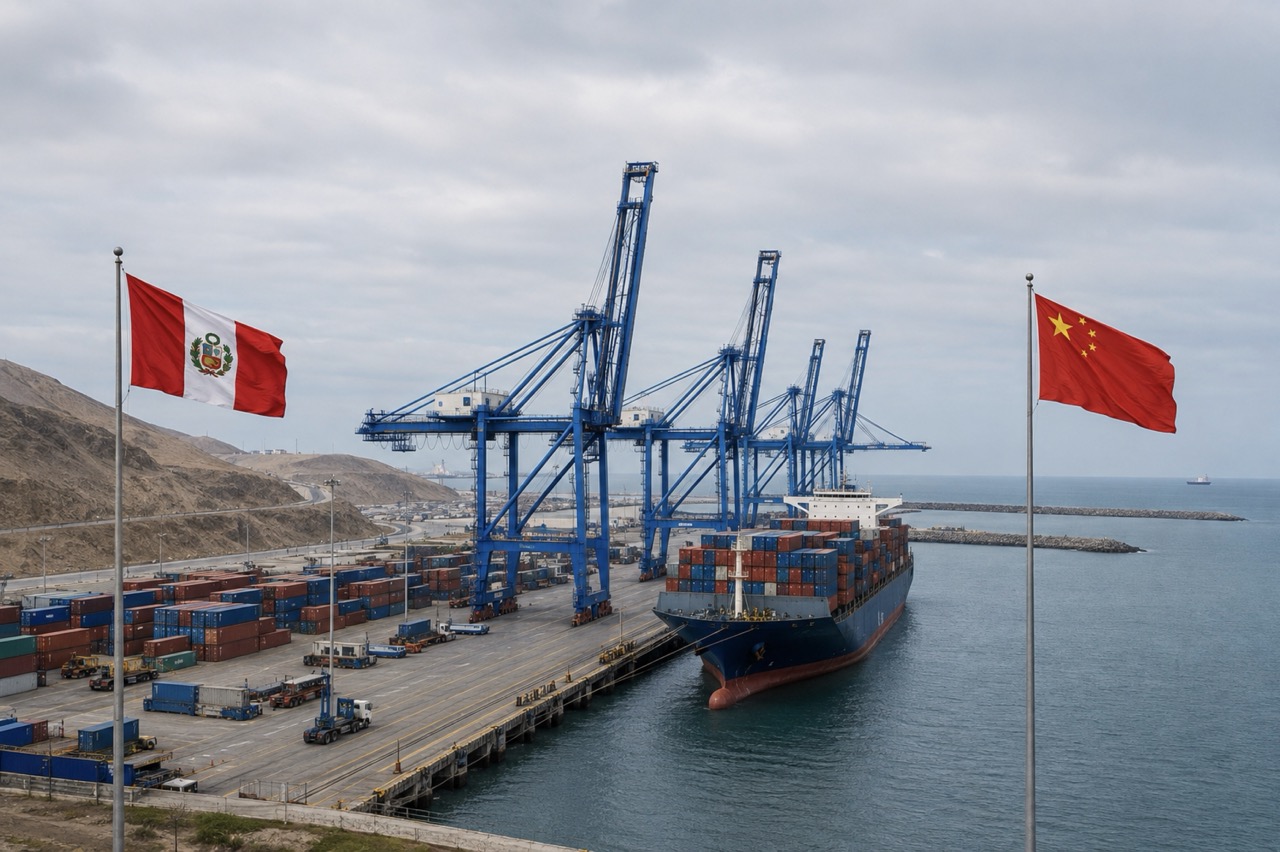
European debates about dependency on China concentrate on physical inputs: semiconductors, batteries, rare earths, and the ports that move them.[19] This paper argues that the coordination of global value chains has meanwhile shifted into a layer those debates reach only late: the data layer. China is building systematic advantage there while Europe regulates without building.
The data layer of global value chains is the infrastructure of visibility: the platforms, standards and databases that carry information about goods flows and thereby coordinate them. Whoever controls this layer influences priorities, prices and the allocation of capacity without owning a single vessel or warehouse. Control of flows increasingly follows from control of data about flows, not from ownership of assets.
That formulation is no longer only analytical. The Commission’s EU Ports Strategy of 4 March 2026 devotes a section to digital autonomy for economic security and states that “whoever controls the data also controls the flows”, noting that European operators are “often dependent on foreign hard- and software, with much of the bloc’s data stored outside the EU”.[13] The premise is now official European policy; the instruments are not. The Strategy answers with guidelines on transport-chain data sharing by 2028, a cybersecurity risk assessment by 2027, and criteria on foreign ownership of strategic port infrastructure. It names no third country anywhere in the text.
This paper takes that premise seriously and asks what follows from it. Chinese state and platform actors observe European goods flows in growing detail, while Europe has no symmetric insight into Chinese flows and no shared view of its own. This is a strategic dependency of the same class as raw-material dependencies, but one that appears in no trade statistic and triggers no screening instrument.
The timing gives the argument its urgency. The main European instruments for freight and customs data enter into force between 2025 and 2028, so their architecture is being decided now. The paper traces how China builds its position in the data layer, examines the European response, and closes with the implications for EU policy.
Analytical approach
The paper does not evaluate individual technologies. It traces how control migrates across three layers of a digitalised value chain: the physical flows of goods, the data about those flows, and the orchestration built on that data. The argument is that competition between China and Europe has moved up this stack, from the first layer to the second and third, faster than European policy frameworks have followed.
The three layers separate questions that dependency debates usually merge. A country can own terminals and still depend on foreign data infrastructure; it can lose manufacturing and still hold the orchestration layer. Reading the relationship through this stack also explains why dependency in the data layer stays invisible: nothing crosses a border, nothing is acquired, and nothing appears in customs records.
The evidence base is documentary: platform disclosures, regulatory texts and government assessments. Prior EuroHub4Sino work has traced how China engages in technical standardisation on two fronts, inside established standards bodies and through its own Belt and Road channels,[16] how the “soft” connectivity of standards travels with the “hard” connectivity of infrastructure and technology,[14] and how Chinese standards policy balances state control against competitiveness.[15] This paper extends that pattern one level down, from standards to the operational data infrastructure of trade itself.
How China builds the data layer
China’s position in the data layer rests on a tandem: state-run infrastructure on one side, platform ecosystems on the other.
The state track is LOGINK. It began in 2007 as a provincial initiative in Zhejiang, is subsidised by the Ministry of Transport and housed within the China Transport Telecommunications and Information Center, and is offered free of charge to ports, carriers and forwarders.[1][2] It aggregates data from some 5 million trucks, more than 200 logistics warehouses worldwide and over 450,000 users in China, and has concluded agreements with at least 24 ports, freeports and port operators outside China, seven of them in Europe: Antwerp, Bremen, Hamburg, Barcelona, Sines, Riga and Rotterdam.[1][2][18] It has also partnered with PortBase in the Netherlands, with CargoSmart, and with the International Port Community Systems Association, whose membership spans dozens of ports worldwide [2][18]. CargoSmart is a subsidiary of Orient Overseas, which COSCO acquired in 2018. The pricing is the policy: a free, state-subsidised platform builds adoption, and adoption builds the data position. The US assessment places this expansion inside the Digital Silk Road, through which “China also aims to control data and information flows that accompany the movement of goods”, and notes that LOGINK is contributing to an ISO standard for visibility data interchange between logistics information service providers.[1]
The United States has drawn its conclusion. The FY2024 National Defense Authorization Act bars the Pentagon from using any seaport in the world that runs LOGINK and requires the Secretary of State to open talks with allies on removing the system from their ports.[2] The congressional assessment behind that measure warned that the platform could give the Chinese state access to shipping information, cargo valuations drawn from customs clearance forms, and routing data.[1] The European response has so far been a reminder that ports must handle sensitive data securely and in compliance with EU rules.[2]
The platform track runs through e-commerce logistics. Cainiao, Alibaba’s logistics arm, opened its main European hub at Liège Airport in 2021 under a 2018 agreement with the Belgian government, a first phase of roughly 30,000 square metres with an announced investment of EUR 100 million that Chinese officials presented as Belt and Road cooperation.[4] Cainiao reported handling nearly 5 million cross-border parcels a day across its network,[4] and in September 2024 announced a second batch of global e-hubs toward worldwide delivery within 72 hours.[3] Physical expansion is not linear. Cainiao abandoned a planned enlargement at Liège in late 2025, but the data position built through such nodes does not retreat with the concrete.[17]
The direct-from-factory model of Temu and Shein compresses the value chain around this infrastructure. In 2024, 4.6 billion parcels valued under EUR 150 entered the EU, 91 per cent from China.[5] Each is a data point in an end-to-end system linking Chinese factories to European households, whose operators see demand, routing and price formation across the whole chain. European retailers and carriers see their own fragment.
The scale matters less than the direction of learning. A platform that observes European demand at item level can steer production, inventory and pricing faster than a competitor working from customs statistics and quarterly reports. Visibility becomes orchestration: the second layer feeds the third.
The two tracks reinforce each other, and in a familiar pattern. Fuchs and Eaton describe China’s engagement in global standardisation as two-pronged: mastering practice inside established bodies such as ISO while diffusing its own practice abroad through the Belt and Road.[16] Seaman adds that Chinese standards internationalise through concrete investment, soft connectivity accompanying hard.[14] LOGINK follows the same two prongs one level down. It contributes to an ISO standard for visibility data interchange while extending bilateral port agreements under the Digital Silk Road,[1] and Cainiao and the e-commerce platforms add the commercial adoption that turns a standard into an operating dependency.
Europe: regulation without infrastructure
The European Union has answered the digitalisation of value chains mainly with law. The eFTI Regulation obliges member state authorities to accept electronic freight transport information from 9 July 2027.[6] The European Maritime Single Window environment applies from 15 August 2025.[7] The Data Act has applied since 12 September 2025.[8] On the customs side, the Council gave final approval on 11 February 2026 to rules removing the EUR 150 duty exemption; a flat EUR 3 duty per product category has applied to low-value consignments since 1 July 2026 and runs until the EU customs data hub becomes operational in mid-2028.[9][10]
Each instrument is defensible; none yet produces a shared European view of flows. eFTI is being implemented through national gates constructed separately, so the likely outcome is 27 digital silos where paper silos stood.[6] The Data Act grants rights but supplies no infrastructure through which a carrier or authority could see a chain end to end. The Ports Strategy diagnoses the problem precisely: “B2B data exchange is fragmented and often bound to proprietary software”. It answers it with guidelines by 2028, a year after the eFTI obligation begins.[13]
The market has not filled the gap. TradeLens, the platform built by Maersk and IBM from 2018, was discontinued in early 2023; Maersk’s head of business platforms explained that “the need for full global industry collaboration has not been achieved” and that the venture “has not reached the level of commercial viability necessary to continue”.[11] Its surviving counterpart is GSBN, incorporated in Hong Kong in 2021, six of whose eight founding shareholders are based in mainland China or Hong Kong: COSCO Shipping Lines, COSCO Shipping Ports, OOCL, Hutchison Ports, SPG Qingdao Port and Shanghai International Port Group, alongside Hapag-Lloyd and PSA International.[12] The Western-led neutral platform failed on adoption; the China-anchored consortium became the default.
The contrast carries a design lesson, and the Commission has independently drawn the same one: better integration of systems “can improve supply chain visibility without imposing centralised platforms”.[13] TradeLens failed as a centralised platform run by one dominant carrier, which competitors declined to feed with their data; a European capability that repeats that design will repeat that outcome. The workable alternative is federation: national and sectoral systems that keep their data but expose it through common standards. The eFTI and single-window architecture could become if interoperability is enforced rather than encouraged.
This is the European position in the data layer: binding obligations, fragmented implementation, a correct diagnosis, and no infrastructure of its own between them.
Implications: visibility asymmetry as strategic dependency
The combined result is a visibility asymmetry. Through LOGINK agreements, platform logistics and e-commerce flows, Chinese state and commercial actors observe European supply chains at shipment level. Europe has no equivalent view of Chinese chains and, more strikingly, no consolidated view of its own.
The asymmetry has a peacetime cost and a crisis cost. In normal times it shows up as a competitive disadvantage: European firms negotiate rates, plan capacity and position inventory with less information than counterparts plugged into the Chinese data ecosystem. In a disruption it becomes a security exposure, because rerouting decisions depend on who sees congestion, capacity and cargo first.
Two objections deserve an answer. The first holds that logistics data is mundane, so its aggregation carries no strategic weight. The US assessment points the other way: aggregated flow data reveals cargo valuations, routing patterns and dependency structures, which is why Washington treated a logistics platform as a security matter.[1] In a crisis, whoever sees flows first decides first.
The second expects European regulation to generate the missing infrastructure by itself. TradeLens shows why this is optimistic: even a well-funded private platform with regulatory tailwinds failed to reach critical mass, and eFTI’s national gates are reproducing fragmentation inside legal harmonisation.[6][11] Rights and obligations do not aggregate data; infrastructure does.
The policy conclusion is not to exclude Chinese platforms from European logistics. It is to govern the layer where dependency now forms: recognise logistics data as critical infrastructure, gain an overview of what leaves the Union and under which agreements, and connect the instruments Europe is already building into a federated visibility capability. Those instruments are eFTI, the maritime single window and the customs data hub. The Commission has stated the premise; what is missing is the sequencing and the binding force, and the window is open only while these systems are still under construction. Chips, batteries and raw materials taught the Union how expensive an unexamined dependency becomes. The data layer offers the rare chance to act before the dependency matures.

 | Funded by the European Union. Views and opinions expressed are however those of the author(s) only and do not necessarily reflect those of the European Union or European Research Executive Agency (REA). Neither the European Union nor the granting authority can be held responsible for them. |
[1] U.S.-China Economic and Security Review Commission (September 20, 2022). ‘LOGINK: Risks from China’s Promotion of a Global Logistics Management Platform.’ Staff Issue Brief. Available at: https://www.uscc.gov/research/logink-risks-chinas-promotion-global-logistics-management-platform (Accessed: September 2, 2026).
[2] Tereza Corradi (February 22, 2024). ‘China’s LOGINK: Securing Maritime Data in European Ports.’ China Observers in Central and Eastern Europe (CHOICE), Association for International Affairs (AMO). Available at: https://chinaobservers.eu/chinas-logink-securing-maritime-data-in-european-ports/ (Accessed: September 6, 2026).
[3] Cainiao Group (September 10, 2024). ‘Cainiao Doubles Down on Global Logistics Network with Launch of Second Batch of Global e-Hub Construction.’ PR Newswire. Available at: https://www.prnewswire.com/apac/news-releases/cainiao-doubles-down-on-global-logistics-network-with-launch-of-second-batch-of-global-e-hub-construction-302242814.html (Accessed: September 6, 2026).
[4] Flanders-China Chamber of Commerce (2021, undated). ‘Cainiao Networks opens smart logistics hub at Liège Airport.’ Available at: https://www.flanders-china.be/en/newsletterpublications/cainiao-networks-opens-smart-logistics-hub-at-liege-airport. The investment figure is the company’s own, reported by Alizila (Alibaba Group’s news platform), ‘Factbox: Cainiao Creates 200 Jobs in Belgium as it Kickstarts Hiring at its Smart-Logistics Hub in Liege Airport.’ Available at: https://www.alizila.com/factbox-cainiao-creates-200-jobs-in-belgium-as-it-kickstarts-hiring-at-its-smart-logistics-hub-in-liege-airport/ (Accessed: September 1, 2026).
[5] Council of the European Union. ‘EU action on the influx of small parcels.’ Available at: https://www.consilium.europa.eu/en/policies/eu-action-influx-of-small-parcels/ (Accessed: September 4, 2026).
[6] Regulation (EU) 2020/1056 of the European Parliament and of the Council of 15 July 2020 on electronic freight transport information. Available at: https://eur-lex.europa.eu/eli/reg/2020/1056/oj. On the 9 July 2027 acceptance obligation and national gate implementation see European Shippers’ Council (2025). ‘EU advances paperless freight: key developments in the eFTI regulation.’ Available at: https://europeanshippers.eu/eu-advances-paperless-freight-key-developments-in-the-efti-regulation/ (Accessed: September 4, 2026).
[7] Regulation (EU) 2019/1239 of the European Parliament and of the Council of 20 June 2019 establishing a European Maritime Single Window environment and repealing Directive 2010/65/EU, applicable from 15 August 2025. Available at: https://eur-lex.europa.eu/eli/reg/2019/1239/oj (Accessed: September 2, 2026).
[8] Regulation (EU) 2023/2854 of the European Parliament and of the Council of 13 December 2023 on harmonised rules on fair access to and use of data and amending Regulation (EU) 2017/2394 and Directive (EU) 2020/1828 (Data Act), applicable from 12 September 2025. Available at: https://eur-lex.europa.eu/eli/reg/2023/2854/oj (Accessed: September 5, 2026).
[9] Council of the European Union (February 11, 2026). ‘Council gives final green light to new customs duty rules for small parcels.’ Press release. Available at: https://www.consilium.europa.eu/en/press/press-releases/2026/02/11/council-gives-final-green-light-to-new-customs-duty-rules-for-small-parcels/ (Accessed: September 2, 2026).
[10] European Commission, DG Taxation and Customs Union (November 13, 2025). ‘E-commerce: 150 EUR customs duty exemption threshold to be removed as of 2026.’ Available at: https://taxation-customs.ec.europa.eu/news/e-commerce-150-eur-customs-duty-exemption-threshold-be-removed-2026-2025-11-13_en (Accessed: September 6, 2026).
[11] A.P. Moller-Maersk (November 29, 2022). ‘A.P. Moller-Maersk and IBM to discontinue TradeLens, a blockchain-enabled global trade platform.’ Available at: https://www.maersk.com/news/articles/2022/11/29/maersk-and-ibm-to-discontinue-tradelens (Accessed: September 6, 2026).
[12] Global Shipping Business Network (March 17, 2021). ‘Global Shipping Business Network Successfully Incorporated to Accelerate the Digital Transformation of Global Shipping and Trade.’ Available at: https://gsbn.trade/global-shipping-business-network-successfully-incorporated-to-accelerate-the-digital-transformation/ (Accessed: September 4, 2026).
[13] European Commission (March 4, 2026). Communication from the Commission to the European Parliament, the Council, the European Economic and Social Committee and the Committee of the Regions: EU Ports Strategy, COM(2026) 112 final. Available at: https://eur-lex.europa.eu/legal-content/EN/TXT/PDF/?uri=CELEX:52026DC0112 (Accessed: September 4, 2026).
[14] John Seaman (February 2025). ‘Technical Standards, Soft Connectivity and China’s Belt and Road: Towards greater convergence or fragmentation?’ ReConnect China Policy Brief 19, republished by EuroHub4Sino. Available at: https://eh4s.eu/publication/technical-standards-soft-connectivity-and-chinas-belt-and-road-towards-greater-convergence-or-fragmentation (Accessed: September 1, 2026).
[15] John Seaman (October 30, 2024). ‘AI and Technical Standardization in China and the EU: Diverging priorities and the need for common ground.’ ReConnect China Policy Brief 16, republished by EuroHub4Sino. Available at: https://eh4s.eu/publication/ai-and-technical-standardization-in-china-and-the-eu-diverging-priorities-and-the-need-for-common-ground (Accessed: September 5, 2026).
[16] Daniel Fuchs and Sarah Eaton (2024). ‘Practice diffusion in China’s two-pronged engagement in global technical standardization.’ China Information 38(2). Available at: https://doi.org/10.1177/0920203X241245686; republished by EuroHub4Sino: https://eh4s.eu/publication/practice-diffusion-in-chinas-two-pronged-engagement-in-global-technical-standardization (Accessed: September 6, 2026).
[17] ‘Alibaba cancels Liège expansion’ (October 30, 2025). Ecommerce News Europe. Available at: https://ecommercenews.eu/alibaba-cancels-liege-expansion/ (Accessed: September 2, 2026).
[18] Gabriel Collins and Jack Bianchi (April 25, 2023). ‘China’s LOGINK Logistics Platform and Its Strategic Potential for Economic, Political, and Military Power Projection.’ Baker Institute for Public Policy, Rice University. Available at: https://www.bakerinstitute.org/research/chinas-logink-logistics-platform-and-its-strategic-potential-economic-political-and (Accessed: September 6, 2026).
[19] Niklas Swanström (February 26, 2026). ‘China’s PLA and Europe’s Supply Chain Trap: Navigating U.S. Pressure and China’s Influence.’ EuroHub4Sino Policy Paper 2026/4. Available at: https://eh4s.eu/publication/chinas-pla-and-europes-supply-chain-trap-navigating-u-s-pressure-and-chinas-influence (Accessed: September 3, 2026).